Free Study Guide for Ilst Reading Teacher Content Exam
Welcome to the FTCE Elementary Educational activity K-6 Exercise Test and Prep page. We'll be introducing you to the cadre subtests and key concepts you need to know to laissez passer this exam. This is one of the gratis resources we provide so you tin see how prepared you are to accept the official FTCE Simple Didactics K-6 Test.
Quick Links to Help Y'all Navigate This Page
- FTCE Elementary Education One thousand-6 Exam Overview
- FTCE Uncomplicated Education K-vi FAQs
- FTCE Elementary Education K-6 Pinnacle Tips
- Linguistic communication Arts and Reading Overview
- Social Science Overview
- Science Overview
- Mathematics Overview
The FTCE Elementary Education K-half dozen is a required examination for anyone seeking teacher certification in grades K-6 in Florida. The test covers content and content pedagogy.
There are four subtests:
- Language Arts and Reading
- Social Science
- Science
- Mathematics
If this is your kickoff time to have the exam, yous must register for the full examination (all four subtests). Afterward a first endeavour, you can register for any combination of subtests. You have to pass all subtests to earn a passing score for the test.
The exam is a calculator-based examination, but don't worry, you just demand basic computer skills. If yous made it to this betoken in your education and career, you accept nothing to worry most.
Here is the subtest format and time allotment breakdown:
| Subtest | Questions (Multiple-Choice) | Fourth dimension (Minutes) |
|---|---|---|
| Language Arts and Reading | sixty | 65 |
| Social Scientific discipline | 55 | 65 |
| Science | 55 | 70 |
| Mathematics | 50 | lxx |
Cost: $150 for the total examination (commencement effort)
Retake: $37.fifty (one subtest); $75 (2 subtests); $112.l (three subtests); $150 (four subtests)
Location: Tests are by engagement only, twelvemonth-round.
What to Bring: You need to bring two valid, unexpired forms of identification in English language.
Number of Attempts: There are no limits on how many times you lot can take the test before you laissez passer; all the same, you do have to look 31 days between testing attempts.
Scoring: Yous need to score at least 200 points per subtest. All 4 subtests must be passed. When you finish taking the test, you will immediately go an unofficial pass/not-pass upshot (unless they are experiencing score report delays). You can look your official score within four weeks.
Register for the FTCE Elementary Teaching Thou-vi exam here.
- What FTCE exam exercise I demand to take?
-
The Bureau of Educator Certification (BEC) determines your testing requirements after yous employ for certification. Click hither for more info.
- How long volition the FTCE Elementary Education K-6 test take me?
-
The full test itself is 270 minutes simply await to be at the testing site longer. It takes time to get checked in and become started. Program to arrive at least thirty minutes before your appointment time.
- Practise I get a break during the FTCE Elementary Education K-6 test?
-
Yes. If you are taking three or more than subtests, you will get a scheduled 15-minute break. This break does count as testing fourth dimension, however.
- What tin I expect when I arrive at the testing site to take the FTCE Elementary Instruction K-6 test?
-
When yous go there, look to have your identification checked, your photo taken, your palm scanned, your eyeglasses checked, and to identify your belongings in secure storage. Y'all volition be given an erasable notepad and pen. Before starting the test, you'll have to complete a short tutorial and sign an agreement.
- Can I meet what answers I got wrong on the FTCE Simple Pedagogy Thou-half dozen test?
-
If yous don't pass a subtest, yous may be eligible to register for a score verification session where you tin review incorrectly answered multiple-choice questions. At this time, you lot could also submit scoring challenges if you feel there is an error.
- Is the FTCE Simple Education Thou-6 test difficult?
-
Information technology is challenging.
In 2017 the passing rates were:
Subtest Passing % Language Arts and Reading 54% Social Science 64% Science 65% Mathematics 61% - How practice I pass the FTCE Elementary Teaching K-half dozen test?
-
To pass the FTCE Elementary Education 1000-6 test, yous must first empathise what is on the examination and what you lot will be expected to know. The best style is to review the 240Tutoring examination breakdown materials and practice questions. In one case you identify areas of weakness, y'all can begin targeting those areas with instructional content and practise questions.
- Make sure to answer every question (even if yous estimate)
- Know how much time you have left
- Eliminate incorrect answers outset
- Work through practice questions so you know what to wait
- Study quality, trusted sources (similar 240Tutoring)
Overview
You volition have 65 minutes to consummate 60 multiple-choice questions.
The FTCE Elementary Education One thousand-half-dozen Linguistic communication Arts and Reading subtest can be neatly divided into v different sections. Those five sections are:
- Reading Procedure
- Literary Analysis and Genres
- Language and the Writing Procedure
- Literacy Instruction and Assessment
- Advice and Media Literacy
Reading Process

This section involves but understanding how students larn to read and then taking that knowledge and teaching students how to read.
Reading process questions make upward most 29% of the Language Arts and Reading subtest.
In that location are three big concepts you definitely have to know to get these questions right:
- Emergent Literacy
- Text Analysis
- Teaching Strategies
Emergent literacyis basically what a pupil understands about reading and writingearlierhe/she tin can read and write words. Information technology'south actually the kickoff step in the literacy process. Literacy means the power to read and write.
You need to know terms like phonological awareness, concepts of impress, and decoding. And yous need to know the steps in both oral and written linguistic communication evolution.
Text analysisincludes knowing the master parts of comprehension. Comprehension means understanding something. So, basically, students need to empathise what they read.
Brush upwards on terms like main idea, supporting details, author'south purpose, point of view, inference, and decision. Also, exist able to determine the best means to explain and use charts, tables, pictures, etc. in texts to help students understand the book meliorate.
And the last is didactics strategies. You need to know the best practices for teaching decoding skills, fluency development, vocabulary across content, reading comprehension, and critical thinking skills.
Be very sure you know the components of fluency, as well (accuracy, automaticity, rate, and prosody). At that place are lots of ways to teach these things, but some ways are considered "best."
Now, those are the iii wide concepts to be familiar with.
Specific Concepts
Correct now, I'grand going to give y'all three specific concepts to exist familiar with considering they will most likely appear on the examination.
Phonological Sensation
The first specific concept is phonological awareness. This is simply the ability to hear and distinguish between the smallest unit of sound. And the smallest unit of sound is otherwise known every bit a phoneme. Developing phonemic awareness among students is actually going to assist them as they acquire to sound out words.
Now, there are a few best practices for educational activity phonemic awareness, so y'all demand to brand sure that you research and sympathize what those best practices are.
Concepts of Print
The second specific concept is concepts of print. This simply means basic knowledge about text. Even more simply, does a student know how a book works? It includes reading from left to right, reading from height to bottom, knowing that the letters make words that transport a message, using "render sweep" (motility from 1 line to the next) and that every book has a forepart, back, and author.
In that location are several assessments out there that examination a pupil'southward concept of print.
You demand to know what information technology is, why it's important, how to assess it, and how to teach it.
Fluency
And finally, you lot need to know what fluency is and what the main parts of information technology are. In really simple terms, fluency is being able to read words correctly and quickly and not sound like a robot. The large parts of fluency are accurateness, automaticity, rate, and prosody. You need to know what these words hateful.
Accuracy is reading the words correctly.
Automaticity is knowing the words right abroad. You don't have to sound annihilation out or think virtually information technology. Yous just know it.
Rate is basically how many words a pupil can read per minute. But the kicker here is that a student needs to encompass what they read. So, if they read fashion too fast and don't understand what they simply read, that's no proficient. They need to read at a rate that also allows them to sympathize what they read.
Prosody is a fancy word for expression. Basically, you don't want to sound like a robot. You want to read in phrases, not word by word.
Literary Analysis and Genres
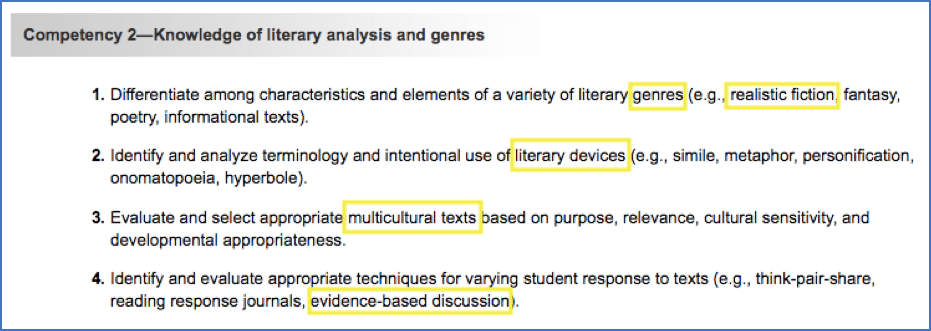
This section includes knowing nigh the different kinds of books and beingness able to call back about them and answer to them in a higher-level way.
Literary analysis and genres questions brand up about 16% of the Language Arts and Reading subtest.
In that location are three big concepts you definitely accept to know to get these questions right:
- Types of Genres
- Literary Devices
- Education Strategies
Types of genres means knowing the dissimilar kinds of books out there. At that place are realistic fiction books, fantasy books, poetry, advisory texts, etc. You need to know the different kinds of books and what makes them different from the residuum (their features).
Literary devices are things author's apply to make their writing special. These include things like similes, metaphors, personification, onomatopoeia, hyperbole, etc. You demand to know what these words hateful and be able to detect examples of them.
And the terminal is teaching strategies. You need to know the best practices for choosing books for instruction and how to teach students to respond to books. This includes different strategies similar recall-pair-share, reading response journals, and evidence-based discussion.
Be sure to know what multicultural texts are and why they are important to apply.
Those are the iii large concepts to know and empathise.
Specific Concepts
At present, here are three specific concepts to be familiar with because they will nearly likely appear on the test.
Realistic Fiction
The first specific concept is knowing what realistic fiction is. Realistic fiction includes stories that could actually happen in real life but didn't. Think Because of Winn-Dixie and Shiloh. The setting, characters, and plot could happen or could have already happened. There isn't anything magical or brand-believe nearly them.
Evidence-Based Discussion
The 2nd specific concept to know is what evidence-based give-and-take is. Basically, students must employ evidence, or proof, from a volume to justify their answers or comments. If they can't prove it with clues from the volume, it probably isn't right. Only like a person can't exist prosecuted for a law-breaking without evidence, a student tin't draw a conclusion from a book without evidence. Testify is central.
So, y'all need to know how to facilitate, or guide, students to have show-based discussions most books.
Multicultural Texts
And the last specific concept to know is what multicultural texts are and why they are important to apply.
Multicultural texts are books nigh underrepresented groups of people. These groups aren't a part of the "mainstream" in terms of race, ethnicity, organized religion, linguistic communication, etc. Information technology is important for students to be exposed to multicultural books so that they gain a basic understanding of the world and the people in it. These books tin help them understand their own culture and the culture of others.
As a teacher, information technology will be your job to use multicultural books for instruction that are appropriate, sensitive, and relevant. You lot don't desire to employ a volume that is offensive or outdated.
Then, recollect about different means to utilize multicultural books in the classroom.
Language and the Writing Procedure
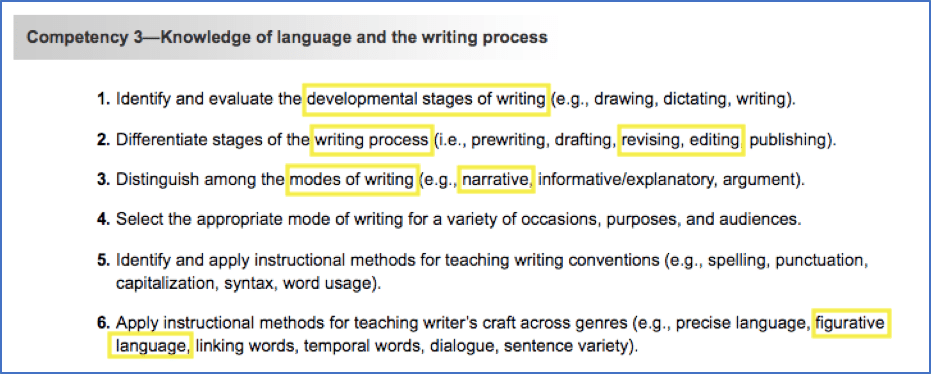
This section involves knowing how students develop in writing, what the writing process is, and how you can effectively teach students to write.
Language and the writing process questions make up virtually sixteen% of the Language Arts and Reading subtest.
There are four big concepts you definitely accept to know to get these questions right:
- Developmental Stages of Writing
- Writing Process
- Modes of Writing
- Education Strategies
The first big concept you have to know are the developmental stages of writing. The stages of writing development volition go from when a kid is first learning to write (scribbling) to when they're starting to use grammer and the effectively points of grammer to make their signal.
The stages of writing development are:
- Scribbling
- Mock messages
- Letter germination
- Word writing
- Judgement construction
- Spelling, punctuation, and grammatical expression
And so, make certain you're familiar with each stage of writing evolution, the characteristics, what students need to learn, and what kind of instructional activities they demand to progress on to the side by side stage.
The writing process is specifically referring to what needs to happen to go from a not completed writing assignment to a completed writing assignment.
The stages of the writing procedure are:
- Prewriting
- Drafting
- Revising
- Editing
- Publishing
Make sure you know the purposes of each stage and how students should engage in each stage.
So, what should students exist doing during the prewriting phase that differs than in the writing stage? And what should students be doing during the revision stage that's unlike than in the editing stage?
All of this is almost guaranteed to come on the test.
Modes of writing describes the different ways students can write.
The different modes of writing include:
- Narratives
- Informative/Explanatory
- Argument
You need to know the difference betwixt the modes and how to select the near appropriate mode of writing for a variety of occasions, purposes, and audiences.
And the last big concept is instruction strategies. Y'all need to know the best practices for teaching writing conventions.
Writing conventions include:
- Spelling
- Punctuation
- Capitalization
- Syntax
- Word usage
Yous as well need to know how to teach the craft of writing. This means that yous can teach students to effectively use precise linguistic communication, figurative language, linking words, temporal words, dialogue, and sentence diversity.
Know those terms and the best practices for teaching them.
Those are the four big concepts to know and empathize.
Specific Concepts
Now, here are three specific concepts to exist familiar with because they will nigh likely appear on the test.
Revising versus Editing
The beginning specific concept to know is the difference between revising and editing. They are non the same thing!
Revising ways you change a few words or sentences to make your writing ameliorate. Y'all may clear up any confusing parts or add together more details. The content of your writing changes.
Editing means you fix errors in your writing like spelling, capitalization, punctuation, etc. Maybe y'all forgot to capitalize someone's name or put a catamenia at the cease of a sentence. The content of your writing does not modify.
And so, be sure you know the difference between revising and editing.
Narrative Writing
The second specific concept to know is what narrative writing is. A narrative is a story (usually most a personal experience). The reader typically learns a lesson at the end of the story.
Nigh narratives include a theme, characters, setting, and plot. The plot is the principal events of the story.
Afterward knowing what a narrative is, yous need to know how to use the writing process to teach students how to write a narrative. This includes prewriting, drafting, revising, editing, and publishing.
And so, know what a narrative is and how to teach students how to write ane.
Figurative Language
And the last specific concept is figurative language. Figurative language is when you apply words or phrases in a different way than normal.
Figurative language includes:
- Alliteration
- Hyperbole
- Metaphor
- Onomatopoeia
- Personification
- Simile
In that location are more kinds of figurative language, simply these are the ones most likely to come up on the test. Know these terms and be able to place examples of each.
Literacy Instruction and Assessment
This section involves knowing how students develop in writing, what the writing procedure is, and how you can effectively teach students to write.
This section includes knowing how to teach students to read and write, knowing how to monitor and assess students' reading and writing skills, and knowing how to analyze those assessments to see what you need to do adjacent.
Literacy instruction and cess questions make up nigh 23% of the Language Arts and Reading subtest.
In that location are three large concepts you definitely take to know to get these questions correct:
- Teaching Strategies
- Literacy Cess
- Information Analysis
The start large concept yous demand to know is teaching strategies for literacy. Basically, you demand to know different ways to teach students to read and write. There are a few best practices for didactics that you need to be familiar with: literature circles, small groups, workshops, reading centers, and multiage groups.
Know what those are and how to implement each in your classroom.
The next big concept is literacy cess. This means that you lot should be able to track student progress in dissimilar ways, understand what the data is proverb, and make plans to help students who just aren't getting it.
Now, within each of those three things, at that place are several things y'all need to know considering they will more than likely pop up on the examination.
Here are some different kinds of assessments:
- Norm-referenced
- Criterion-referenced
- Diagnostic
- Curriculum-based
At that place are more, but these are the ones that you need to know for the test. Be sure to know what they are, when yous should use them, and what makes them different from the rest.
In that location are too different means to appraise how students are doing:
- Informal reading inventories
- Fluency checks
- Rubrics
- Story retelling
- Portfolios
Know what these are and the all-time times to utilise them.
The concluding large concept to know is data analysis. Basically, y'all demand to be able to apply all that assessment info and make activity plans to aid students succeed in reading and writing. This information should help you plan your instruction. It should besides guide your talks with students and their parents.
Then, know how to expect at educatee information and use that data to drive your decisions in the classroom.
Those are the 3 large concepts to know.
Specific Concepts
Now, here are 3 specific concepts to know.
Norm-Referenced versus Benchmark-Referenced
A norm-referenced test compares a student's progress to other students.
A criterion-referenced test compares a student's progress to a set of standards. It doesn't consider how other students did.
Now, these are two very different types of assessments with different goals and knowing when and where to use each assessment is going to come up up on the test.
Intervention
This is a set of steps that a instructor takes to help a student ameliorate reading or writing skills. If you notice a educatee is struggling, this is what you practise to help them.
Don't forget that yous have to document everything. If you don't write information technology down, it didn't happen. Adept documentation can actually help both a student and the teacher.
Multiage Groups
Multiage grouping means putting students of varying ages together in the same classroom or group. The idea is that these students can learn from each other.
You should know how multiage groups can aid students learn to read and write.
Communication and Media Literacy
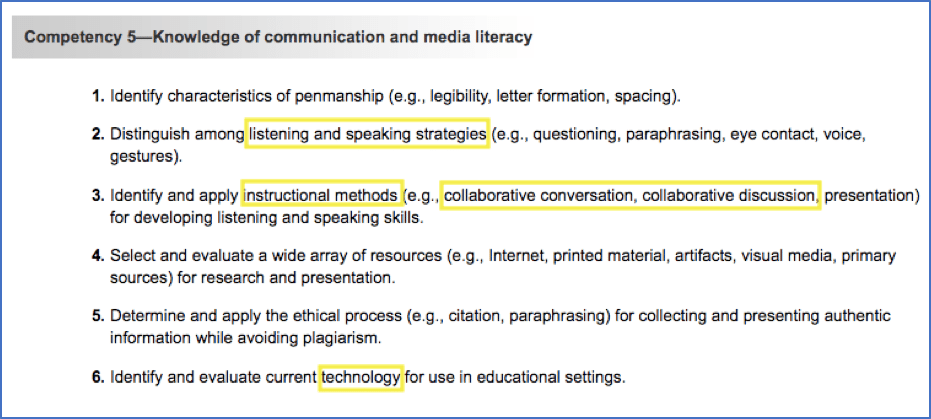
This department involves knowing different means to communicate with students and how to use technology accordingly in the classroom.
Communication and media literacy questions make up about sixteen% of the Language Arts and Reading subtest.
There are three big concepts y'all definitely have to know to get these questions correct:
- Communication techniques
- Teaching strategies
- Technology
The first big concept to know is communication techniques. There are different ways to communicate with students. This includes:
- Questioning
- Paraphrasing
- Eye contact
- Phonation
- Gestures
Of class, there are way more than. Just these are the top ones to know for the test. Know what they are and how you can use them to communicate with students.
Another big concept is teaching strategies for developing listening and speaking skills. These can include:
- Collaborative conversation
- Collaborative discussion
- Presentation
Know what these are and how to utilise them in the classroom.
Y'all should also exist enlightened of effective written communication. Focus on what skillful penmanship contains (legibility, letter of the alphabet formation, and spacing).
Finally, the last big concept to know involves technology. Y'all demand to know about the different kinds of technology you tin utilize in the classroom and the correct way to use that technology.
There is a right and incorrect fashion to use engineering. Brand sure you lot know how to avoid plagiarism (copying someone else's piece of work) by correctly giving credit to that person.
Those are the three large concepts to know.
Specific Concepts
Let'south talk about three specific concepts that will probably evidence up on the test.
Collaborative Conversation or Give-and-take
These are talks between students (either one-on-one, in groups, or teacher-led) where, you guessed it, they talk about a topic. The key here is that students tin can build on each other's ideas or find solutions to bug. Collaborative learning is definitely a best practice you need to know about.
Know what collaborative conversation is, why it'south of import, and when to use it as an instructional method.
Agile Listening/Speaking
Beingness an active listener means that you are fully concentrating and focused on what a speaker is proverb. You aren't just "hearing" what is being said simply listening. Active listening uses more than just your sense of hearing.
Active speaking is more than than but proverb words. The style you say something normally means more than what yous say. Remember eye contact, torso language, tone, gestures, etc.
You lot need to know not only how to do both of these things, merely how to teach students to be both active listeners and speakers.
Two big means that students learn is through modeling and thinking aloud. If students see y'all being an active listener and speaker, they are likely to follow your lead.
Electric current Technology
The mod classroom uses a wide variety of technology. Call up:
- Smartboards
- Chromebooks
- iPads
- Digital textbooks
- Cameras
- Networked learning
And there are and so many more. Take some time to search online about different kinds of applied science existence used in classrooms.
Know what they are and how they can exist used to enhance student learning.
And that's some basic info virtually the FTCE Uncomplicated Education Grand-6 Language Arts and Reading subtest.
Overview
You lot will have 70 minutes to complete 55 multiple-choice questions.
The FTCE Unproblematic Education K-half-dozen Science subtest can exist neatly divided into 5 different sections. Those five sections are:
- Scientific Instruction
- Scientific Procedure
- Concrete Science
- World and Space Science
- Life Science
Scientific Instruction
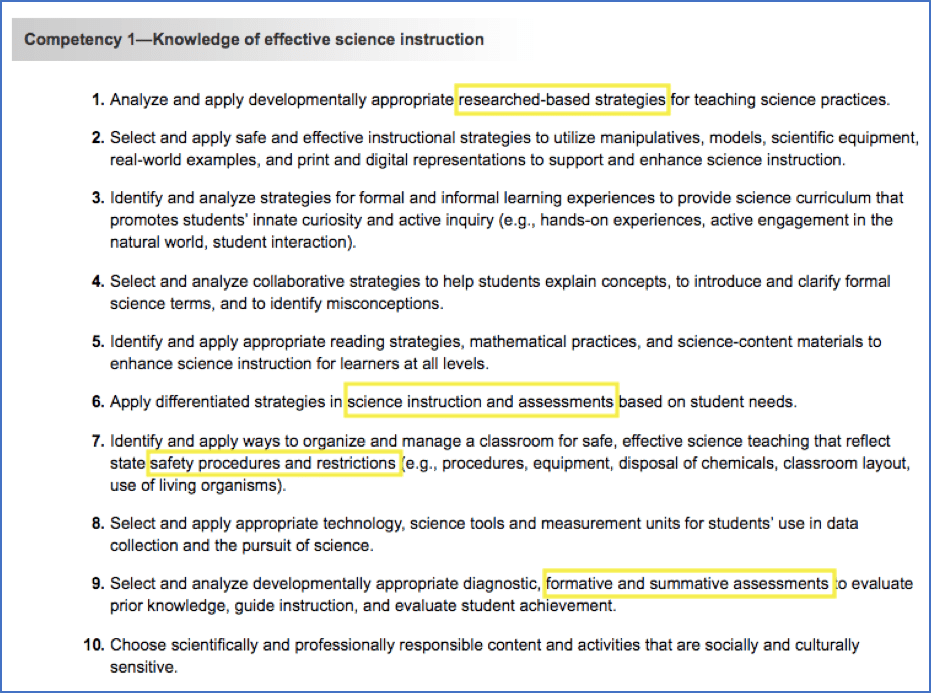
This department tests your knowledge virtually how to teach students scientific discipline concepts and skills and so assess those skills.
Scientific didactics makes upwards nigh twenty% of the Scientific discipline subtest.
There are three big concepts to know considering they will more than likely appear on the test:
- Scientific inquiry
- Lab safety
- Scientific assessment
The commencement big concept to know is how to teach students the process of scientific research. To larn more than about the globe, scientists utilize skills such as observing, predicting, classifying, inferring, and making models.
Sometimes a large set of related observations tin can be continued by a unmarried explanation. A science teacher must sympathize and communicate the importance of scientific inquiry and the office it plays in solving problems effectively and in answering questions in everyday life.
In that location are research-based strategies for teaching scientific inquiry.
You need to know the scientific enquiry process, why it'due south of import to teach students, and how to teach it.
Lab condom is super of import considering information technology keeps everyone safe. And safe students are able to learn.
You need to know the basic lab safety requirements and common rules like:
- Never put chemicals dorsum into the container.
- Always wear goggles.
- Launder hands before and later experiments.
- Directly the openings of containers away from the confront.
- Do non eat or drink in the lab.
There are many more lab safety rules. These are only a few. Take some time to research more and why they are of import.
The concluding big concept to know is how to assess students' scientific discipline skills. You lot need to appraise students in a diverseness of ways using both formative and summative assessments. These assessments should guide future scientific discipline lessons. As the teacher, you should besides provide students with feedback on how they are doing with specific science skills.
Retrieve well-nigh different ways to assess students' science noesis.
So, those are the large concepts.
Specific Concepts
Permit's take a look at some specific concepts that could pop up on the exam.
Formative versus Summative Assessment
A determinative assessment is the ongoing cess of a student'south learning. The goal is to monitor student learning.
A summative assessment is the concluding appraisal of a pupil's achievements. The goal is to evaluate student learning.
Know the difference betwixt the two types of assessments and how you may use both of them for scientific discipline teaching and assessment.
Lab Safety Symbols
To make certain students are safety, in that location are several lab safe symbols that y'all, the teacher, need to know and teach students. These include symbols for:
- Safety goggles required
- Caution with potentially delicate equipment
- Gloves required
- Open up flame caution
- Hand washing required
In that location are several more than. Exercise an Cyberspace search of lab safety symbols and familiarize yourself with them.
Scientific Process
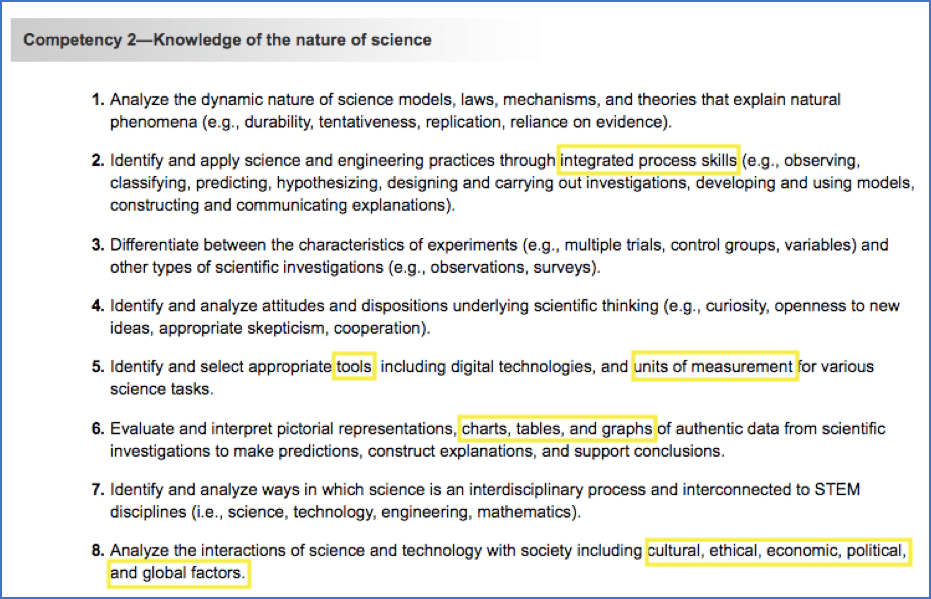
This department tests your knowledge on how to provide opportunities for students to investigate the natural earth through advisedly planned processes.
Scientific process questions make upwardly about eighteen% of the Science subtest.
At that place are three big concepts to definitely know for the examination. They are:
- The scientific method
- Scientific tools
- Effects of science
The beginning big concept is knowing what the scientific method is. The scientific method is a style to enquiry using steps to solve a problem and gathering data to achieve a conclusion.
The steps of the scientific method may look a petty different from grade to course, but here are the basic steps:
- Brand an observation
- Grade a question
- Form a hypothesis
- Conduct an experiment
- Clarify the data
- Draw a conclusion
- Communicate the decision
Know the basic steps of the scientific method and what each ane looks similar in the classroom.
Scientific tools include the metric organisation (units of measurement), data organizers (charts and graphs), digital technologies, and lab equipment.
You'll exist using all of these to teach science.
I'll go into item with a couple of these, but you lot should know what these are and know several examples of each.
And the last large concept to know is the furnishings of scientific discipline on civilisation, ethics, the economy, politics and the world.
Remember about conservation, alternative energy sources, cloning, stem cell research, genetic testing, fitness and health, human reliance on fossil fuels, and many, many more.
Those are the big concepts to know.
Specific Concepts
Hither are some specific concepts that have a good chance of showing upwardly on the examination.
Units of Measurement and Abbreviations
You demand to know the units of measurement for the metric system, which is the standard system of measurement that we use.
Commit these units to retentivity:
- meter: measures length
- liter: measures book
- gram: measures mass
- second: measures time
- newton: measure weight
Also, note these abbreviations:
- kilo: k units
- hecto: 100 units
- deca: 10 units
- deci: 1/10 unit
- centi: 1/100 unit
- milli: ane/1000 unit
Information technology would be smart for you to exercise conversions within the measurement system.
Types of Charts and Graphs
Y'all also need to know the different types of charts and graphs y'all will use for science teaching. They are:
- Data table
- Bar graph/histogram
- Line graph
- Circle graph
Know what each of these are, what they wait similar, and how they display information.
Kinds of Lab Equipment
Equally a science teacher, you volition need to know almost the different kinds of lab equipment and how to properly use and clean them. These tools include:
- Balances
- Beaker tongs
- Beakers
- Graduated cylinders
- Microscopes
- Burners
- Erlenmeyer flasks
- Eyewash station
These are simply a few but are the most common equipment.
Physical Science
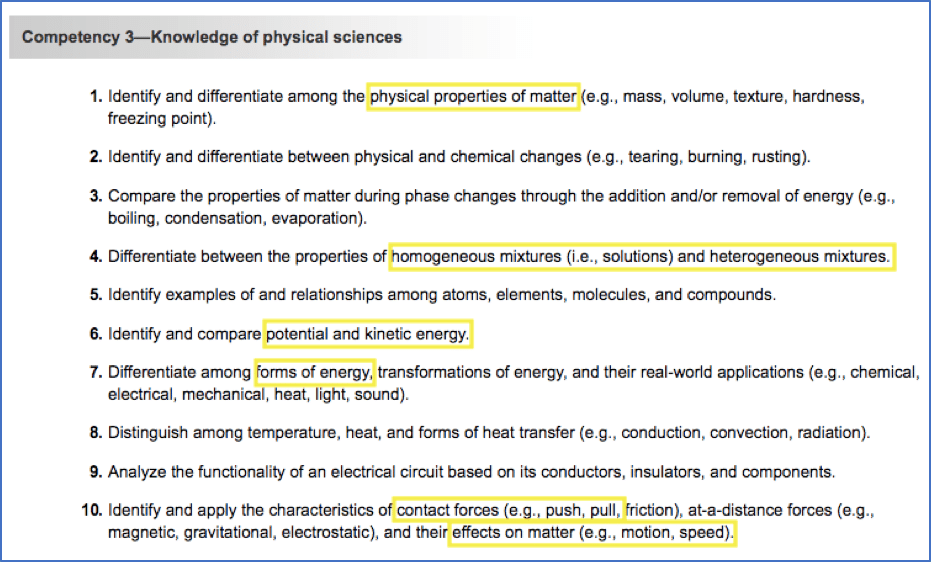
This section tests your noesis about non-living systems (think physics, chemistry, astronomy, etc.).
Physical science questions brand up about 20% of the Science subtest.
In that location are 3 large concepts to know. They are:
- Force and Motility
- Physical and Chemic Properties
- Free energy
The offset big concept to know is strength and move.
Motion is the physical alter in position of an object in proportion to a point of reference.
Force is a button or pull on an object.
You should also know these terms:
- speed
- velocity
- dispatch
- momentum
- friction
- inertia
- mass
- buoyancy
- density
- work
Also, expect up Newton's Laws. You need to know these for the test.
Physical and chemical properties are ways to allocate thing. By the way, matter is anything that has mass and takes up space.
Physical properties are the concrete characteristics of matter or energy.
Chemical properties are the characteristics of a substance's reactions that change the identity of the substance.
You demand to know almost the Periodic Table of Elements, the different types of pure substances and mixtures, what concrete and chemical changes are, u.s. of matter and their characteristics, and the pH scale.
The last big concept to know is energy. Free energy is the power to do work or apply a force over a distance.
Know that energy is never created or destroyed; it only changes forms. And information technology can exist transferred is a agglomeration of different means.
There are two broad kinds of energy: kinetic and potential. Know what these are and the differences between them.
At that place are too many forms of energy similar chemical, electrical, estrus, light, audio, etc.
Specific Concepts
At present let's await at some specific concrete science concepts.
Homogeneous and Heterogeneous Mixtures
In a homogeneous mixture, or a solution, all of the substances are evenly distributed (think blood, air, and salt water). All of information technology looks the same.
In a heterogeneous mixture, the substances are not evenly distributed and await dissimilar (think chocolate scrap cookies, beach sand, and the air with clouds).
Make sure you know the departure betwixt these 2 mixtures.
Potential and Kinetic Energy
Recall, energy is the ability to do piece of work or apply a force over a distance. There are 2 broad classifications of energy.
Potential energy is stored energy. A rock on the border of a cliff has potential energy because gravity might pull information technology down.
Kinetic energy is the energy of motility. When potential free energy is used, it turns into kinetic free energy. So, if that rock falls downwardly the side of the cliff, during its fall, it has kinetic free energy.
Brand sense? Good! Exist sure to know the difference between potential and kinetic free energy.
Newton's Laws
Newton's outset law, the police of inertia, says that an object resists changes in its state of movement. Remember this? "An object in move will stay in motion unless acted on by an equal or opposite force." Recall about why seatbelts are important.
The second law explains why objects with greater mass crave more force to move the object. Forcefulness = mass * acceleration.
Newton'southward third police explains why objects move in the reverse direction of the greater forcefulness. "For every activeness, there is an equal or reverse reaction."
Take some time to wait up Newton and his laws of movement.
Earth and Infinite Science

This section tests what yous know about the earth, its characteristics, and space, and its characteristics.
Earth and space science questions make up about 19% of the Science subtest.
There are three actually big concepts to know:
- World Systems
- Weather and Climate
- Solar System and the Universe
The first big concept to know is nearly earth's systems. This includes knowing the structures of earth, especially geologic formations similar mountains, volcanoes, and canyons.
You should also know the four layers of earth and their characteristics.
Other things to research include the different spheres (atmosphere, geosphere, biosphere, and hydrosphere), plate tectonics, rocks and minerals, soil, and heat transfer from the sun.
This is a super broad concept. A report guide could actually come in handy to help prepare you for the test. I know of a practiced one!
Another big concept to know includes conditions and climate. The main deviation between weather and climate is time. Conditions describes the conditions over a short menses of time, while climate is the average daily conditions for a long period of time.
Some important words to know are:
- humidity
- seasons
- wind
- temperature
- air pressure
- density
- h2o vapor
- barometer
- psychrometer
- anemometer
- Coriolis effect
Know what these words mean!
And the last large concept to know involves the solar system and universe. Basically, you lot need to know what'due south out at that place in space (the lord's day, planets, asteroids, stars, comets, meteoroids, etc.) and about the dominicus-moon-world relationship. These systems together create tides and seasons.
As well, exist aware of the lunar cycle and its process and stages.
Finally, brush up on key events in space exploration and their effects on guild.
Those are the big concepts to know about world and space science.
Specific Concepts
Okay. Let's talk about some specific earth and space science concepts.
The Water Cycle
Now, the h2o bike is actually talking about how water goes from the sea into the atmosphere, turns into pelting, falls on state, and so is transferred back to the ocean.
You come across, the water cycle is i of the pillars of life on Earth. So, nosotros have to understand it to get questions right on that Earth and Space Science department.
Make sure y'all know the stages of the water cycle, what drives the water bike, and these words:
- evaporation
- condensation
- humidity
- precipitation
- surface runoff
Characteristics of Soil
Soil formation occurs due to the weathering and erosion of rocks.
There are 5 components of soil:
- minerals
- organic cloth
- living organisms
- h2o and air
- nutrients
Brand certain yous know what is in each component.
The process of soil formation takes many hundreds (or thousands) of years. Then, a really long time.
Major Events in Space Exploration
There take been a lot of advancements in space exploration. Just there are really a few, big key events that have really affected society. Here are a few:
1957: The first satellite, Sputnik, is launched into infinite.
1961: The commencement human, Yury A. Gagarin, successfully orbits earth. It takes one 60 minutes and 20-ix minutes.
1969: The kickoff lunar landing, Apollo 11, makes Neil Armstrong, Edwin Aldrin, Jr., and Michael Collins household names. Remember? "That'south one small step for man, ane behemothic bound for mankind."
1990: The Hubble Telescope is launched into space.
In that location have been many more happenings in infinite exploration, only these probably had the biggest effects on lodge. Read about these events and how they affected the world.
Life Science
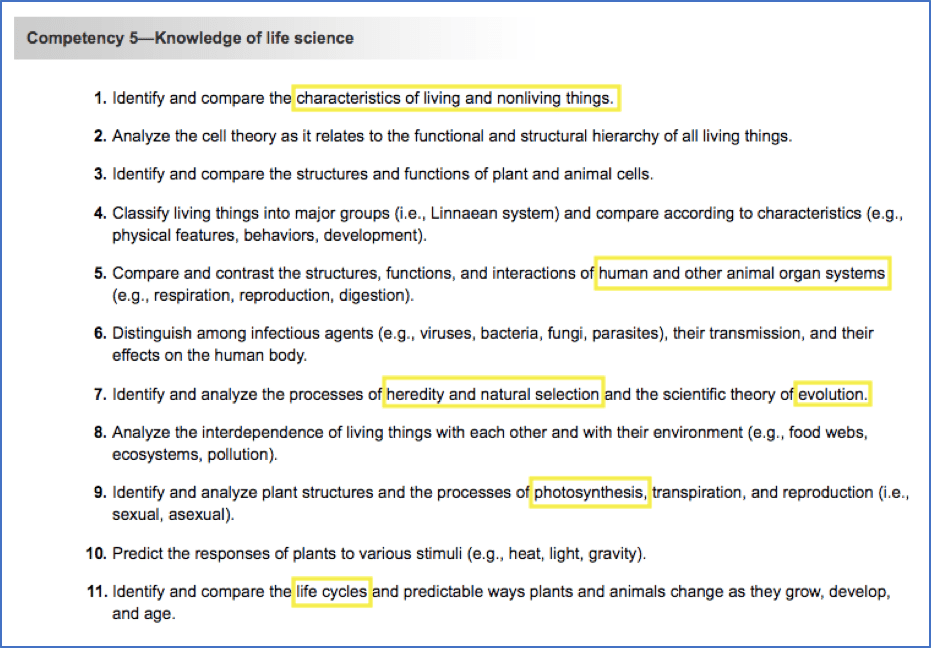
This section tests your cognition on living things and life processes.
Life scientific discipline questions make up about 23% of the Science subtest. Information technology's a large one.
In that location are iii pretty big concepts you need to know:
- Living Things
- Evolution and Alter
- Genetics
The beginning large concept to know is well-nigh living things and their life cycles.
Yous need to know how organisms can exist classified. At that place are 3 big domains:
- prokaryotes
- eukaryotes
- archaebacteria
So, you can interruption those down into half-dozen kingdoms:
- animal
- plant
- fungi
- protist
- eubacteria
- archaebacteria
From there, you tin continue to sort living things into categories by phylum, class, order, family unit, genus, and species. This ranking is called the taxonomic hierarchy. Exist sure to know what all of these words mean.
You besides need to know what a cell is, both plant and animal, and what parts make up a jail cell.
Finally, make sure you know the man body systems, parts of a plant, the life cycles of animals and plants, and how both animals and plants reproduce.
At that place is then much information to know here. A thorough report guide would exist an excellent resources to apply.
Some other big concept to know is well-nigh development and change. Living and non-living things in an environment are partners in keeping an ecosystem in remainder. Living things constantly collaborate with their environment. Organisms can change in response to ecology conditions, and the surround can change in response to a population or grouping of organisms.
Brand sure you can define these terms:
- development
- accommodation
- population
- extinction
- natural choice
- selective breeding
- mutation
Finally, the last big concept to know is nigh genetics. Genetics is the written report of traits passed down from parents to offspring.
There are several terms to know:
- traits
- heredity
- sperm
- egg
- allele
- gamete
- meiosis
- mitosis
- genotype
- phenotype
- dominant
- recessive
Also, know what DNA and RNA is and how they are different.
So, those are the large (very big) concepts to know.
Specific Concepts
Here are some specific life scientific discipline concepts that are probable to announced on the test.
Living versus Non-living Things
There are seven characteristics of living things:
- use free energy
- movement
- breathing
- get rid of waste
- grow and develop
- respond to environment
- reproduce
Some non-living things may accept a couple of these characteristics, but a living thing volition have all of them.
Be sure to know these characteristics and what they mean.
Human Body Systems
You besides need to know the dissimilar systems within the human trunk. They include:
- circulatory
- digestive
- endocrine
- integumentary
- lymphatic
- muscular
- nervous
- renal
- reproductive
- respiratory
- skeletal
Take some time to research these systems and discover out what they are, what they do, and be able to compare them to other animal'southward organ systems.
Photosynthesis
Photosynthesis is the procedure plants use to convert light free energy into chemical energy. In simpler terms, it is how plants utilise the sun to brand food for themselves.
Be sure to understand this process.
And that's some very basic info about the Science subtest.
Overview
You will accept lxx minutes to complete 50 multiple-selection questions.
The FTCE Elementary Education K-vi Mathematics subtest can be neatly divided into five different sections. Those 5 sections are:
Student Thinking and Instructional Practices
- Number Concepts, Operations, and Algebraic Thinking
- Fractions, Ratios, and Integers
- Measurement, Data, and Statistics
- Geometry
You will exist given a Mathematics Reference Sheet to use on the examination. Click here to see what'south on information technology.
So, let'south start with educatee thinking and instructional practices.
Educatee Thinking and Instructional Practices
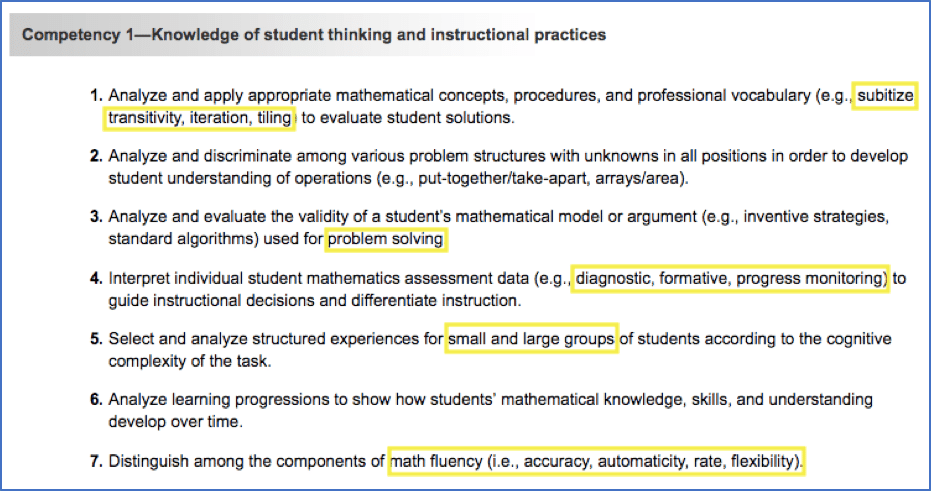
This department tests your knowledge on how students call back about math and how you lot, the teacher, should teach math (aka "best practices").
Student thinking and instructional practices questions make up near 26% of the Mathematics subtest.
There are three pretty big concepts to know:
- Major Theories of Learning
- Educational activity Strategies
- Assessment
The first big concept to know is the major theories of learning and how they tin can be practical to math. Start of all, there are a lot of theories almost how children learn. But here are some important ones to read and retrieve about:
- Behaviorism
- Constructivism
- Social Learning
- Sociocultural Learning
More specifically, take a look at these theories:
- Piaget's Four Stages of Cognitive Development
- Blossom's Taxonomy
- Levels of Geometric Thinking (van Hieles)
Be sure to know what each of these are and how they can be applied to math.
You should likewise read over Florida'south standards for each grade level. You lot can do that by clicking hither.
The side by side big concept is pedagogy strategies. Remember, as I've said a few times earlier now, there are "best practices" for teaching each subject.
Take a wait at this publication by National Council of Teachers of Mathematics (NCTM). They outline some effective teaching practices for math.
Also, be sure to know what manipulatives are, why they are important to apply, and exist aware of some specific manipulatives like geoboards, pattern blocks, number lines, base of operations ten blocks, tangrams, etc.
You besides need to know the importance of using small groups to differentiate math instruction.
Finally, the last big concept to know is how to assess students' noesis in math. Know these types of assessments and when to use them:
- diagnostic
- formative
- progress monitoring
Recollect, assessments should guide your planning and instruction and help y'all differentiate for each student.
So, those are the big concepts to know concerning student thinking and instructional practices.
Specific Concepts
Permit's take a look at some pretty specific concepts that are probable to announced on the test.
Problem-Solving Structure
Problem-solving is a critical skill that students demand to chief in all subjects, including math. Let'south take a look at a detail problem-solving model called Polya's Model. Hither are his 4 steps to problem-solving:
- Understand the problem
- Devise a plan
- Carry out the program
- Review/ostend/extend
Now, at that place are a lot of problem-solving methods out at that place, merely all of them are basically some form of Polya's original four steps. And in that location are several strategies you lot can use to devise a plan (Stride 2) like working astern and using a formula.
Be certain you are able to utilize the four steps to solve a math problem.
Math Fluency
Y'all really need to know the dissimilar components of math fluency and why it's important for your students to be fluent in math. The components of math fluency are:
- accuracy
- automaticity
- rate
- flexibility
These components are a little scrap different than reading fluency.
Accuracy ways solving issues with the all-time method, the right steps, and in the right society to get the correct answer.
Automaticity ways knowing the answer to a problem right abroad. You've washed it and so many times that its well-nigh just an instant reflex. An case is knowing right abroad that x 10 3 = thirty.
Rate is all about beingness efficient. You can complete the steps of problem-solving speedily. You know exactly what footstep to accept next and don't waste fourth dimension beingness "lost".
Finally, flexibility means that y'all are comfortable using more than one approach to solve a problem. You understand numbers and operations well, so you can manipulate the information and think critically. If you don't know the answer right abroad, yous know a mode to figure it out.
Professional Vocabulary
These are some words you lot demand to know. How do I know? Because they appear right in the description of the skill that y'all will be tested on. It'south like the country is handing you a footling gift. Take reward of this gift and learn these words!
Subitizing is a way of instantly counting (example: yous see a group of dots and know immediately that there are ten, without counting).
Transitivity. Okay. Stay with me here. Think of three elements. We volition call them A, B, and C. Transitivity means that if A is related to B, and B is related to C, then A and C must besides be related to each other. Get it?
Iteration is when you lot repeatedly solve a problem using a result from a previous trouble.
Tiling is when yous put individual tiles together with no gaps or overlaps.
Number Concepts, Operations, and Algebraic Thinking
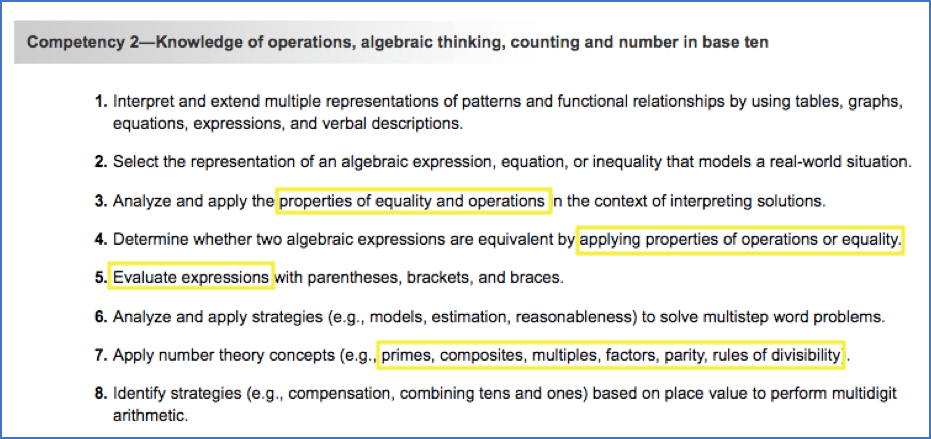
This section tests what you know about numbers, if you lot can dispense those numbers, and how well you can do algebra.
Number concepts, operations, and algebraic thinking questions brand up virtually 28% of the Mathematics subtest.
Here are some specific concepts to know.
Properties of Math
Think of a belongings as kind of like a rule y'all need to follow. Okay? There are quite a few of these properties.
- Commutative Holding of Add-on
- Commutative Property of Multiplication
- Associative Property of Addition
- Associative Property of Multiplication
- Distributive Belongings
- Condiment Identity Holding
- Additive Changed Property
- Multiplicative Identity Property
- Multiplicative Changed Property
Whew. Like I said, there's a lot. You need to know what these are and how to solve problems using them. A really thorough study guide would be a great resource to accept and use.
Solving for x
Solving for x is pretty straightforward. The exam will give you an equation and so you have to solve for x. So, the test will give y'all an equation like:
4×2– four(3 + ii) = sixteen
And in this equation, we would only need to balance the equation for x, so y'all would simplify it as much as y'all can, rest the equation, and yous'd find that x equals three.
iv×2 – four(5) = xvi
4×2 – 20 = 16
4×ii= 36
x2= 9
x = three
Order of Operations
The gild of operations, or PEMDAS, P-E-MD-AS, is simply the process you follow to simplify and work an equation.
Let me give you an example. If you lot have an equation similar this:
two(10 – 3) + 3(x + iv)two
You have to piece of work the problem according to a specific order, the order of operations.
In this detail example, you would kickoff solve for the parentheses, then you would solve for the exponents. Then going left to right, you practise either multiplication or division then y'all would add or subtract in the aforementioned order (from left to right).
And then that's why we group the M and the D and the A and the S together.
At present, this is incredibly important considering, on the test, you will be required to simplify an equation. So, you lot have to know the order of operations to get that question correct.
Number Theory Concepts
You need to know what these words hateful and how to utilise them to solve issues:
- prime
- blended
- parity
- multiples
- factors
- rules of divisibility
So, these are merely a few concepts that volition announced in this department of the subtest.
Fractions, Ratios, and Integers

This department tests your ability to solve word issues and equations with fractions, ratios, and integers. You lot volition also have to compare fractions and integers and place them on a number line.
Fractions, ratios, and integers questions make upward eighteen% of the Mathematics subtest.
Let's talk about some specific concepts that will for sure be on the examination.
Value of Integers
Y'all need to know the value of specific, and sometimes irregular, integers.
Now, the examination will, and I mean will, take you identify dissimilar forms of numbers from greatest to least or least to greatest. Sometimes you'll place those numbers on a number line.
In a given data ready, you might accept two fractions, a decimal, the number pi, a negative integer, and a regular integer and you must organize all these from least to greatest.
Then, make sure you know how to interpret decimals to fractions and fractions to decimals, and then you lot tin can compare the two and effigy out which i is greater or less.
Oh, and likewise make certain you understand decimals to the hundredths place.
Fraction Operations
On the test, you will be asked to add together, subtract, multiply, and divide fractions, including mixed whole numbers and fractions. You also demand to know these words:
- reciprocal (multiplicative changed)
- mixed whole number
- simplify
- numerator
- denominator
Give-and-take Problems
At present, the last major concept to know is how to read, structure, and utilise mathematical word problems, especially those containing fractions and ratios.
Now, my biggest tip to help y'all in this is just to work through a lot of authentic exercise questions, specifically, word problems in mathematics.
Now, while these questions aren't going to be the most complex, it does take a lot of practice to learn how to read a question prompt, understand the mathematical question the prompt is conveying or asking, then taking that and boiling information technology down so you can solve for it.
And really, it'south just one of those things you lot accept to practice, practice, do. And then, find a neat source of authentic exercise questions that you tin can use.
Measurement, Data, and Statistics
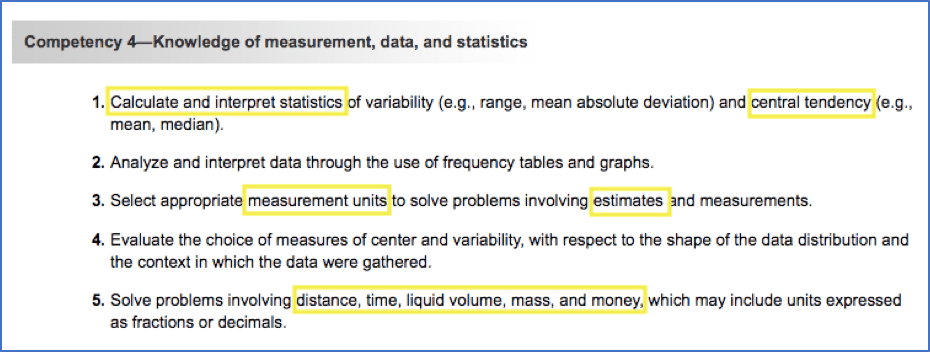
This section involves analyzing sets of data, using measurement units to solve problems, and calculating and interpreting statistics.
Measurement, data, and statistics questions make up about 16% of the Mathematics subtest.
Here are some concepts that are more than than likely to announced on the test.
Fundamental Tendency Measurements
Then, what's almost guaranteed to testify upwardly on the examination? Central tendency measurements. What's central trend measurement?
It's merely four concepts: mode, median, mean, and range.
Now, on the test, they're going to give y'all a data set of well-nigh 8 to 12 numbers, and they're going to ask you one or more of the following. What is the mode? What is the median? What is the hateful? Or what is the range of the information set?
So, you have to know what those primal trend measurements are and how to observe them for a information set. And when you practice, piece of work on a data set of about 8 to 12 double-digit numbers.
Measurement Units
You're going to need to know bones measurement concepts.
The first is how to gauge or guess. Information technology's pretty straightforward.
The 2nd is simply to be familiar with dissimilar units of measurement. Units like temperature, fourth dimension, money, mass, weight, volume, speed, and percentages.
Now, but similar with discussion bug and number concepts, this mathematical concept isn't necessarily complex, you just need to make sure you lot're familiar with those dissimilar types of measuring units.
Interpret Statistical Models
And the last major concept is how to translate different statistical models.
And actually, information technology'southward specifically regarding either standard deviation or quartiles.
Many times, when I've seen a question similar this, the examination will provide some sort of information about a prepare of students' scores.
Yous volition then accept to extrapolate based on that information and the concepts of either quartiles or standard deviation.
Geometry
This section tests your knowledge on both 2nd and 3D shapes and your ability to solve problems concerning perimeter, expanse, surface area, and volume.
Geometry questions make upwards about 12% of the Mathematics subtest, then it's the smallest department, but don't underestimate information technology.
Let's talk most some concepts that you'll come across on the exam.
Pythagorean Theorem
The Pythagorean Theorem is used to notice any length of a side of a right triangle (if you know the other 2 sides).
The equation of the Pythagorean Theorem is:
a2 + b2= c2
Where A and B are the two sides of the right triangle and C is the hypotenuse of the triangle.
And I guarantee yous ane thing, if yous take anything from this, take this ane affair: you lot will take a question about the Pythagorean Theorem on the test. That is an accented guarantee. It will near likely be in some sort of word problem.
An example would exist:
Billy walked three blocks west, and 4 blocks north. If Billy walked a straight line, how many blocks would Billy have walked?
Something like that will testify up on the test.
Types and Characteristics of Triangles
And while we're talking about triangles, earlier you accept the test, brand sure you know the different kinds of triangles and their backdrop.
Now, the unlike kinds of triangles you near demand to be familiar with would be:
- right triangles
- isosceles triangles
- equilateral triangles
- scalene triangles
At present, a lot of the differences between the triangles are really going to come down to the differences of interior angles within the triangle.
So, while y'all're studying the different characteristics of triangles, make certain y'all sympathize the different characteristics of the interior angles of the triangles.
Three Dimensional Shapes
You as well need to know how to identify the properties of three-dimensional shapes (sphere, cube, rectangular prism, cone, cylinder, pyramid, etc.). These properties include:
- volume
- faces
- edges
- vertices
Know what each of these are and how to place them. Each three-dimensional shape has a formula for figuring out volume.
And that's some bones information virtually the Mathematics subtest.
This department tests your knowledge on both 2D and 3D shapes and your ability to solve problems concerning perimeter, area, surface area, and volume.
Geometry questions make up nigh 12% of the Mathematics subtest, then it'southward the smallest department, but don't underestimate it.
Let'due south talk about some concepts that you lot'll see on the test.
Pythagorean Theorem
The Pythagorean Theorem is used to discover whatever length of a side of a correct triangle (if y'all know the other two sides).
The equation of the Pythagorean Theorem is:
a2 + b2= c2
Where A and B are the two sides of the correct triangle and C is the hypotenuse of the triangle.
And I guarantee yous one affair, if you accept anything from this, take this one affair: you will accept a question about the Pythagorean Theorem on the test. That is an absolute guarantee. It volition most likely be in some sort of word problem.
An case would be:
Billy walked three blocks westward, and iv blocks north. If Billy walked a straight line, how many blocks would Billy take walked?
Something like that volition show up on the test.
Types and Characteristics of Triangles
And while nosotros're talking most triangles, before y'all take the test, make certain you know the different kinds of triangles and their properties.
At present, the different kinds of triangles you most need to exist familiar with would exist:
- correct triangles
- isosceles triangles
- equilateral triangles
- scalene triangles
At present, a lot of the differences between the triangles are actually going to come downward to the differences of interior angles within the triangle.
And then, while you're studying the different characteristics of triangles, brand sure you understand the different characteristics of the interior angles of the triangles.
Three Dimensional Shapes
You lot also demand to know how to identify the backdrop of three-dimensional shapes (sphere, cube, rectangular prism, cone, cylinder, pyramid, etc.). These properties include:
- volume
- faces
- edges
- vertices
Know what each of these are and how to identify them. Each three-dimensional shape has a formula for figuring out volume.
And that's some basic information almost the Mathematics subtest.
Source: https://www.240tutoring.com/ftce-prep/elementary-education-k-6-practice-test/
0 Response to "Free Study Guide for Ilst Reading Teacher Content Exam"
Post a Comment