Cisco Second-generation 1- and 2-port T1/e1 Multiflex Trunk Voice/wan Interface Cards Review
Contents
Introduction
This certificate provides a sample configuration for the second-generation 1- and ii-port T1/E1 multiflex torso (MFT) vox/WAN interface cards (multiflex VWICs), which support data and vocalisation applications in Cisco multiservice routers. The multiflex VWIC combines WAN interface card (WIC) and voice interface card (VIC) functionality to provide the following improvements:
- Support for both T1 and E1--T1/E1 MFT VWIC2 cards provide additional flexibility in configuring the MFT VWIC2 cards by supporting T1, partial T1, E1, and fractional E1 for both phonation and WAN applications.
- Drop and insert capability on all versions--All MFT VWIC2 modules at present include the drop and insert multiplexing capability, which eliminates external third political party CSU/DSUs and drop and insert multiplexers.
- Enhanced clocking capabilities--The 2-port MFT VWIC2s tin enable each port to be clocked from independent clock sources for information applications. This contained clocking capability is not supported for voice applications and non supported with the AIM-ATM-VOICE-30 module.
- Dedicated repeat cancellation option--MFT VWIC2s take an onboard slot for a multiflex trunk dedicated echo cancellation module (EC-MFT-32 and EC-MFT-64), offering an enhanced repeat cancellation capability for demanding network conditions. For more data well-nigh this characteristic, refer to the "Configuring Hardware Echo Cancellation" chapter in the Phonation Port Configuration Guide.
Prerequisites
Requirements
Before attempting this configuration, delight ensure that yous meet the post-obit prerequisites:
- Cisco IOS Paradigm -- To run these features on T1/E1 interfaces, you must install an IP Plus or IP Voice paradigm (minimum) of Cisco IOS Release 12.3(xiv)T or a afterward release.
- VWIC Support -- The multiflex VWIC cards are supported on Cisco 2600XM series, Cisco 2691, Cisco 2800 series, Cisco 3700 series, and Cisco 3800 series routers when installed on the network modules listed in Components Used. The multiflex VWIC cards tin can as well be installed in any VIC slot on the router.
- Independent Clocking Manner -- The contained clocking way is supported only on these modules:
- VWIC2-1MFT-G703
- VWIC2-2MFT-G703
- VWIC2-2MFT-T1/E1
- VWIC2-1MFT-T1/E1
To enable independent clocking mode, use the keyword independent in the clock source command. Theindependent keyword expands on the clock source internal and clock source line commands to specify that the port can operate on an independent clocking domain. Prior to the add-on of theindependentkeyword, port 0 was the default chief clock source, and port one was the default secondary clock source and is loop-timed. With independent clocking enabled, this dependency no longer exists, and so theindependent keyword means that both ports can be independently clocked.
When independent clocking is configured, the controller volition back up merely one channel group and no vocalism applications. If more than than one channel group is configured, the post-obit error message occurs:
aqueduct-group 2 timeslots 3 %Aqueduct-grouping already created. %Only 1 channel-group tin be configured with independent clocking. %Bereft resource to create channel group
When you are configuring the clock source contained and no clock source independent commands, the channel group has to be removed from the configuration.
Components Used
The information in this document is based on combinations of the network modules supported by the 2d-generation 1- and 2-port T1/E1 multiflex body phonation/WAN interface cards. If your network module is:
- NM-HDV (for VWIC selection, choose 0 or ane), these cards tin be used:
- VWIC2-1MFT-T1/E1
- VWIC2-2MFT-T1/E1
- VWIC2-2MFT-G703
- NM-HDV2 (for VWIC option, choose 0 or i), these cards tin exist used:
- VWIC2-1MFT-T1/E1
- VWIC2-2MFT-T1/E1
- VWIC2-1MFT-G703
- VWIC2-2MFT-G703
- NM-Hard disk drive-2VE (for VWIC choice, choose 0, 1, or ii), these cards tin be used:
- VWIC2-1MFT-T1/E1
- VWIC2-2MFT-T1/E1
- NM-2W, NM-1FE1R2W, NM-1FE2W-V2, NM-2FE2W-V2 (for VWIC option, choose 0, 1, or ii), these cards can be used:
- VWIC2-1MFT-T1/E1
- VWIC2-2MFT-T1/E1
- VWIC2-1MFT-G703
- VWIC2-2MFT-G703
Note: For this feature to work properly, the network modules listed hither must be installed in ane of the following platforms: Cisco 2600XM, Cisco 2691, Cisco 2800 series, Cisco 3662 (telco models), Cisco 3700 series, and Cisco 3800 series.
Conventions
For more information on document conventions, run into the Cisco Technical Tips Conventions.
Background Information
Cardinal Features
The second-generation i- and 2-port T1/E1 multiflex trunk voice/WAN interface cards have the following key features:
- Full support for T1 Facility Data Link (FDL)
- Controller local loopbacks
- Controller remote loopbacks
- RFC 1406 and integrated CSU/DSU MIB
- MIB and Simple Network Management Protocol (SNMP) management
- Firmware to support T1 and E1 Layer 1 homologation
- User-initiated VWIC reset and field-programmable gate assortment (FPGA) download
- Vocalization support (includes DS0-group and PRI-grouping configuration)
The following listing shows the names and descriptions of the modules with second-generation 1- and 2-port T1/E1 multiflex trunk vox/WAN interface cards.
- VWIC2-1MFT-T1/E1-- ane-port RJ-48 multiflex voice/WAN trunk (T1/E1)
- VWIC2-2MFT-T1/E1--2-port RJ-48 multiflex vocalisation/WAN trunk (T1/E1)
- VWIC2-1MFT-G703-- 1-port RJ-48 multiflex trunk (E1 G.703)
- VWIC2-2MFT-G703-- 2-port RJ-48 multiflex trunk (E1 G.703)
Notation: These baseboards tin also provide hardware repeat cancellation if at that place is a daughter card (EC-MFT-32 or EC-MFT-64) mounted on the baseboard. For more than information, refer to the Voice Port Configuration Guide on Cisco.com.
Notation: Although unstructured M.703 operation is detail to E1 performance, the VWIC2-1/2MFT-G703 cards also back up structured T1 functioning.
Integrated Drop and Insert Adequacy
The drop and insert characteristic enables the removal of DS0 time slots from 1 E1 interface and insertion into time slots of the other E1 interface. This feature is bachelor in VWIC applications. If you configure drop and insert, be certain that the E1 framing under the controllers involved (the tdm-groups configuration location) is the same. If y'all use different frame types, the signaling $.25 may not exist read properly. This failure occurs during the drib of a channel from one controller and insertion into a channel from another controller. Drop and insert time slots do not need to be face-to-face.
Configure
In this section, yous are presented with the information to configure the features described in this document.
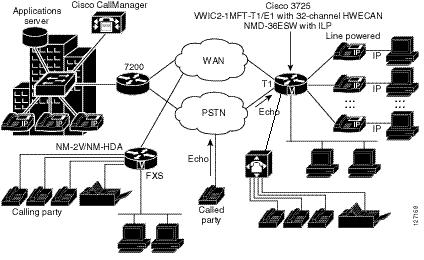
Network Diagram
This document uses the network setup shown in the diagram below.
Configurations
This document uses the configurations shown beneath.
Router# testify run Building configuration... version 12.4 bill of fare type t1 0 0 ! no network-clock-participate wic 0 ip subnet-aught ip cef ! no ip dhcp utilise vrf continued ! controller t1 0/0 framing esf linecode b8zs aqueduct-grouping 1 timeslots ane-12 speed 64 tdm-group two timeslots thirteen-24 ! controller t1 0/1 framing esf linecode b8zs channel-group 1 timeslots one-12 speed 64 tdm-group 2 timeslots thirteen-24 ! ! interface Serial0/0:1 ip accost 10.0.0.1 255.255.255.0 ! interface Serial0/i:1 ip accost ten.0.0.2 255.255.255.0 ! connect t1-xconnect T1 0/0 2 T1 0/i 2 ! !
Router# prove run Building configuration... version 12.iv service timestamps debug datetime msec localtime evidence-timezone service timestamps log datetime msec localtime show-timezone service countersign-encryption ! hostname vnt-2620XM-55a ! kick-start-marker boot-terminate-marker ! card type t1 0 0 logging buffered 64000 debugging enable password seven 095B59 ! no aaa new-model ! resource policy ! clock timezone EST -5 clock summer-fourth dimension EDT recurring no network-clock-participate slot 1 network-clock-participate wic 0 network-clock-select i T1 0/0 voice-card 0 dspfarm no local-bypass ! phonation-menu 1 no dspfarm ! ip subnet-zero ip cef ! ! no ip domain lookup ip host redclay 172.18.108.26 ! ! ! controller T1 0/0 framing esf linecode b8zs ds0-group 0 timeslots 1-24 type fxo-ground-get-go ! controller T1 0/ane framing sf linecode ami ! controller T1 1/0 framing esf linecode b8zs ds0-grouping 0 timeslots i blazon eastward&m-firsthand-commencement ds0-group one timeslots 2 blazon e&g-immediate-starting time ! ! ! interface FastEthernet0/0 ip address 14.80.55.38 255.255.255.0 duplex automobile speed motorcar ! ip default-gateway xiv.80.55.one ip classless ip road 0.0.0.0 0.0.0.0 FastEthernet0/0 ! ip http server ! connect TieA vocalisation-port ane/1/0 T1 i/0 0 ! ! connect TieB voice-port 1/1/i T1 1/0 1 ! ! control-plane ! ! ! vocalization-port 1/0:0 ! voice-port 1/0:1 ! vocalisation-port 1/1/0 betoken firsthand ! voice-port 1/1/ane signal immediate ! ! dial-peer cor custom ! ! line con 0 exec-timeout 0 0 line aux 0 line vty 0 4 exec-timeout 0 0 password vii 131200 login ! ntp clock-period 17180246 ntp server 172.18.106.15 ! stop
Verify
There is currently no verification process bachelor for this configuration.
Troubleshooting
There is currently no specific troubleshooting information bachelor for this configuration.
Related Information
-
RFC 1406, Definitions of Managed Objects for the DS1 and E1 Interface Types
-
ITU-T G.168, Digital Network Repeat Cancellers
-
Network Module Hardware
-
Cisco IOS Vocalization Command Reference, Release 12.iii T
-
Cisco IOS Voice Port Configuration Guide, Release 12.4 T
Source: https://www.cisco.com/c/en/us/support/docs/interfaces-modules/nm-2v-two-voice-fax-interface-card-slot-network-module/65322-tdmfxwic.html
0 Response to "Cisco Second-generation 1- and 2-port T1/e1 Multiflex Trunk Voice/wan Interface Cards Review"
Post a Comment