â€ëœone of the Great Intellects ofã‚â Hisã‚â Timeã¢â‚¬â„¢ by Ray Monk the New York Review of Books

Stephen Burch
Frank Ramsey (correct), with his mathematician begetter, Arthur Ramsey, Lake District, England, 1925
"Well, God has arrived. I met him on the v:15 train."
Thus, in the New year of 1929, was Ludwig Wittgenstein'south return to Cambridge announced by John Maynard Keynes in a letter to his married woman, Lydia Lopokova. Wittgenstein had previously been at Cambridge earlier Globe War I as a pupil of Bertrand Russell, but had acquired his godlike status through the publication afterwards the state of war of his beginning and but volume, Tractatus Logico-Philosophicus, which was very quickly recognized as a work of genius past philosophers in both Cambridge and his home city of Vienna. Wittgenstein himself was initially convinced that it provided definitive solutions to all the problems of philosophy, and accordingly gave up philosophy in favor of schoolteaching. In 1929, however, he returned to Cambridge to think again nigh philosophical bug, having become convinced that his book did not, in fact, solve them once and for all.
What drew him dorsum to Cambridge was not the prospect of working again with Russell, who by this time (having been stripped of his fellowship at Trinity Higher, Cambridge, because of his opposition to World War I) was a freelance journalist, a political activist, and just intermittently a philosopher. Rather, information technology was the opportunity of working with Frank Ramsey, the man who had persuaded him of the flaws in the Tractatus. Virtually significantly, Ramsey had shown that the account Wittgenstein gives of the nature of logic in the Tractatus could not be entirely correct.
Wittgenstein's belief that he had solved all the problems of philosophy rested on ii other behavior: (1) that those bug arose out of a "misunderstanding of the logic of our language" and (2) that in the Tractatus he had corrected those misunderstandings. Ramsey pointed out that there was something fundamentally amiss with Wittgenstein'south ain view of logic, central to which was the insistence that logic is linguistic. Logical relations, that is, agree not betwixt the things or the facts of the earth, but rather between propositions. For instance, from the two propositions "If it is raining, the streets are wet" and "It is raining," nosotros can logically infer a third suggestion, "The streets are wet." That is to say, if the first ii propositions are true, the third is necessarily true. The third follows logically from the other two.
According to Wittgenstein, all logic is like this; if there were no language, there would be no logic. And, if there were no logic, at that place would be no necessity, since all necessity is logical necessity. At that place is no such affair equally a necessary fact. Thus, what Wittgenstein calls an "diminutive proffer," i.e., ane that states a simple fact almost the world, cannot be necessarily true or false; it has to exist contingently true or simulated. It follows that the truth or falsity of one atomic proposition cannot follow from the truth or falsity of others. (In our example of logical inference above, the first suggestion is not an atomic proposition, since its "if A, then B" construction is complex—information technology combines two propositions, A and B, and is therefore, then to speak, molecular rather than atomic.) Atomic propositions must, in other words, be logically contained.
Now, there is a potential problem here, which Wittgenstein himself raises and discusses in the Tractatus. The problem is this: the argument "This is ruby" seems to be as simple as a proposition tin can be. If anything is an atomic suggestion, you might remember, so that is one. And still, from it we seem to be able to infer logically that the (every bit elementary) proffer "This is blue" is false. These two propositions, despite looking paradigmatically atomic, are certainly not logically independent. Wittgenstein's response to this in the Tractatus is to insist that, despite appearances, these two propositions are not atomic.
By using physics, Wittgenstein suggests, these statements might exist analyzable into simpler statements about the velocities of particles and so fifty-fifty simpler statements almost the positions of particles. Thus the contradictory (necessarily false) statement "This is both red and blue" is analyzable into the argument that a particular particle is in two different places at the same time.
In his review of the Tractatus, Ramsey points out that this proposed solution to the problem does non work. "Even supposing," he writes,
that the physicist thus provides an analysis of what nosotros hateful by "red," Mr. Wittgenstein is simply reducing the difficulty to that of the necessary backdrop of space, time, and thing or the ether. He explicitly makes it depend on the impossibility of a particle being in two places at the same time.
This impossibility, Ramsey suggests, is a feature of the world, rather than of our language, thus threatening to undermine Wittgenstein's unabridged theory of logic. Information technology was this devastating criticism that compelled Wittgenstein to revise his opinion that he had solved all the problems of philosophy and to render to Cambridge to study, with Ramsey as his supervisor.
Ramsey was then only twenty-five years old merely already recognized at Cambridge as one of the greatest intellects of his time, non merely by Wittgenstein, only also past, amidst others, Keynes, C.Yard. Ogden, I.A. Richards, and Russell himself. He was to live just one more than year, but in his very cursory lifetime he made central contributions to mathematics, philosophy, and economics. Despite the persistent and widespread admiration he arouses among academics, however, Ramsey is niggling known to the public at large. One of the primary purposes of Frank Ramsey (1903–1930): A Sister's Memoir, past his younger sister Margaret Paul, is to introduce him to a wider audience.
Perhaps because of the deeply felt desire amongst his admirers to see Ramsey receive some public attending at final, this memoir has been very warmly welcomed. David Papineau, a philosophy professor at King's Higher London, reviewing information technology in the Times Literary Supplement, writes that Ramsey "has some claim to be the greatest philosopher of the twentieth century" and calls the book "a sensitive and philosophically well-informed memoir."
What he and others fail to mention, withal, is that in many ways this is a disappointing and unsatisfying book. Margaret Paul died in 2002, and the book was evidently not quite finished at the time of her death. I got to know her while she was writing it and I know how diligently she pursued her piece of work and how determined she was to leave no stone unturned. It therefore seems inconceivable to me that she did not intend to fill some of the glaring gaps that mar the book as it has now been published.
For anyone interested in Wittgenstein, the worst of these gaps occurs betwixt the two last chapters. At the end of the penultimate affiliate, Chapter 17, we reach the climactic moment in January 1929 when Wittgenstein returned to Cambridge. At the beginning of the next chapter, expecting to read about the intellectual interchanges between Wittgenstein and Ramsey, we read instead about Ramsey'south decease from hepatitis in January 1930. The relationship betwixt Wittgenstein and Ramsey during the intervening twelve months—in which they met regularly for philosophical discussions that were of fundamental importance to them both—is passed over in silence.
One is left with the unshakable impression that at least one chapter is missing, which happens to exist the very chapter that many of united states of america most wanted to read. If that affiliate had been written, it would surely have given us a detailed description of the year that Wittgenstein and Ramsey spent together at Cambridge, and traced the influence the ii had on each other, as Wittgenstein attempted to revise his thoughts on logic in the light of Ramsey's criticisms and Ramsey attempted to develop a theory of truth.
This is the virtually egregious, but by no means the only, case of apparently missing cloth. Indeed, in its odd structure and weirdly unbalanced patchiness—dwelling at length on relatively unimportant details while completely ignoring things of deep and lasting interest—this volume recalls another biography that conspicuously failed to deliver on its considerable promise: Abraham Pais's 2006 book on J. Robert Oppenheimer, which also remained unfinished at the time of its author's death.
The volume has its highlights, however. The opening chapter on Ramsey's family, for example, though not especially well written, is extremely interesting. On both his mother'southward and his father'south side, Frank Plumpton Ramsey (the unusual eye proper noun came from his maternal grandfather, who was descended from the de Plompton family that could trace itself dorsum to the Normans) was the product of the British educated upper-heart class. Both his grandfathers were clergymen, one educated at Oxford, the other at Cambridge, while his begetter, Arthur Ramsey, was a mathematics don at Cambridge and the president (equivalent to vice-primary) of Magdalene Higher. Frank, the eldest of four children, was built-in in 1903 and, together with his blood brother Michael (who became famous as the archbishop of Canterbury), was brought upwards in a large house called "Howfield" that Arthur Ramsey had built on a piece of land that he bought from his college. Margaret, their sister, was much younger, existence born in 1917.
In 1915, at the age of twelve, Frank Ramsey was sent to Winchester Higher, ane of the oldest and most distinguished of Britain's public (i.east., private) schools. He was non particularly happy there, just he excelled academically, winning prizes for about everything and establishing himself in particular as an outstandingly gifted mathematician. The chapter on Winchester illustrates the weird imbalance of the book. Though it contains arable information nearly the history and customs of the schoolhouse, it also contains the only mention in the whole volume of Ramsey's most of import contribution to mathematics: his founding of what is now chosen "Ramsey Theory."
Remarking that Ramsey excelled at mathematics while at Winchester, Paul goes on to say that he was equally interested in economics and philosophy, and therefore "it is not surprising that, of all his subsequently published work, but 9 pages were strictly mathematics." She adds, every bit if in parentheses: "These, though, formed the basis of a new branch of mathematics called 'Ramsey Theory.'" 1 looks in vain in the residual of the book for an caption of what Ramsey Theory is or where those nine pages might exist found.
If Paul had lived to finish her volume properly, she would surely accept expanded this business relationship of i of her brother's most notable achievements and put it in its proper chronological place. As but those who already know Ramsey'southward work would realize, what she is alluding to is a newspaper that he presented to the London Mathematical Society at the end of 1928 (only a month earlier Wittgenstein returned to Cambridge and therefore possibly belonging to the period that was to exist covered by a part of the book she never got around to writing). The paper is chosen "On a Problem of Formal Logic" and is twenty-ii (not 9) pages long. It is not, every bit Paul implies, an isolated piece of writing. On the contrary, information technology is of a piece with much else that Ramsey wrote on logic and the foundations of mathematics.
Its starting point is an effort to tackle what was then considered a leading problem in mathematical logic: the Entscheidungsproblem (decision problem), the problem of finding a method for deciding—in a finite number of steps—whether whatsoever given statement of logic or mathematics is or is not logical truth. The trouble was posed by the German mathematician David Hilbert in 1928 (so Ramsey'south paper is one of the earliest discussions of information technology) and was solved in 1936 by Alan Turing and Alonzo Church, who both, separately, showed that there was no such method.
In his own approach to the problem, Ramsey presented what he called "certain theorems on combinations which have an independent interest," and it is these theorems on combinatorics that have established the branch of mathematics named after him. The involvement of Ramsey Theory centers on how certain types of order ascend as mathematical objects get larger. A typical problem in this branch of mathematics would ask something like "How many elements of some structure must at that place be to guarantee that a particular belongings will concord?"
For example, consider plot dots (vertices) on a certain space and the question of how each of them is to exist joined up with others. What is the minimum number of vertices that would guarantee the appearance of an entirely red (or blue) triangle? The respond is six, the proof of which belongs to Ramsey Theory. In a special issue of the Journal of Graph Theory defended to the memory of Frank Ramsey, the mathematician Frank Harary said of Ramsey Theory: "Its results are often easy to state…and difficult to prove; they are beautiful when exact, and colorful. Unsolved problems abound, and additional interesting open questions arise faster than solutions to the existing issues."*
Margaret Paul was herself an economist and her book is a little better on her brother'due south contributions to economics than on his contributions to mathematics. Even here, however, she seems reluctant to go into much depth. She devotes, for example, merely a few sentences to Ramsey's first paper on economics, "The Douglas Proposal," which was published during his second year equally an undergraduate presently earlier his nineteenth birthday. (He entered Trinity College as a mathematics student in 1920 at the age of seventeen.) C.H. Douglas was an engineer who in the 1920s had put frontwards a scheme, known as "Douglas Credit" or "Social Credit," according to which consumers would be given rebates by the authorities that would close the gap between what information technology cost to produce appurtenances and what it cost the consumer to buy them. In his criticism of this scheme, Ramsey brought to bear a new kind of mathematical analysis involving integral calculus. His deeply impressed father described it every bit "a new branch of mathematics." Ramsey'southward conclusion was that the scheme advocated by Douglas would achieve its ends only in infrequent circumstances.
Of far more than lasting importance are 2 papers on economics that Ramsey wrote in the tardily 1920s: "A Contribution to the Theory of Taxation" (1927) and "A Mathematical Theory of Saving" (1928). Paul provides brief but useful summaries of both. The commencement "showed that, on certain assumptions, taxes did the least harm—caused the smallest possible fall in satisfaction—if they were set and then that, as a result of the tax, the product of each good [such equally sugar or corn] fell by the aforementioned proportion." In the second, he "prepare out to discover how much of its income a nation should salve each year" in society to "reach what Frank termed the state of bliss" in which "everyone would have as much equally they wanted of goods." (He concluded that it should save 60 percent of its income.)
The latter of these essays—though he conceded that it was "terribly difficult reading for an economist"—was described by Keynes as
1 of the most remarkable contributions to mathematical economics ever made, both in respect of the intrinsic elegance of the technical methods employed and the articulate purity of illumination with which the author'southward mind is felt by the reader to play virtually its bailiwick.
Extraordinarily, Ramsey wrote this groundbreaking newspaper while working on a book (that he never finished) on logic. What for economists and most mere mortals was "terribly difficult" was, for him, a kind of relaxing distraction, "a waste of fourth dimension." Today, information technology is regarded by economists as 1 of the founding papers in the branch of their subject known as "optimal accumulation," which seeks to calculate the amount of a lodge's economy that should be invested rather than consumed and then as to maximize utility.
Ramsey's initial circuit into economics had been at the instigation of C.K. Ogden, whom he met while however a schoolboy at Winchester and who was, in all sorts of ways, to have a deep influence on his life. Ogden, fourteen years older than Ramsey, had been a classics student at Magdalene and thus had come to the attention of Ramsey's father. While still an undergraduate, Ogden had founded both a weekly journal, The Cambridge Mag, and a discussion group, the Heretics. Ramsey first met him in the spring of 1920, a few months before he entered Cambridge, and in the summer of 1923 wrote him a couple of messages—one about Ogden's book (cowritten with I.A. Richards) The Meaning of Significant and the other about Bertrand Russell'southward philosophy of mathematics—that reveal how astonishingly perceptive, incisive, and critical his heed already was at the age of seventeen.
At Cambridge, Ramsey was speedily accepted by the intellectual elite. Nearly notably, perchance, he was elected a member of the famous conversation club the Apostles, whose other members included many of the leading economists, mathematicians, historians, philosophers, and writers of the mean solar day. At the Apostles he got to know Keynes, who invited him to attend meetings of the select Political Economy Order. Another member of the Apostles, G.Eastward. Moore, was the most influential philosopher at Cambridge. When Ramsey started to attend his lectures, Moore recalled subsequently, "I had soon come to experience of him, as of Wittgenstein, that he was much cleverer than I was, and consequently I felt distinctly nervous in lecturing before him." Moore was at that fourth dimension forty-eight years old, a fellow of Trinity, and the author of several widely influential books and articles; Ramsey was eighteen years old and a first-year undergraduate.
Through his connectedness with Ogden, Ramsey was elected a member of the committee of the Heretics and was besides able to publish a couple of articles in The Cambridge Mag. Ane of these was his piece on Douglas Credit. The other was a review of Keynes'south recently published A Treatise on Probability. Unlike many other aspects of Ramsey's work, his views on probability are expounded in some length in Paul's book. Indeed, she devotes an entire chapter to them, in which she outlines Ramsey'southward 1922 criticisms of Keynes equally well as his more substantial 1926 newspaper "Truth and Probability." She also provides extensive quotations from a newspaper on the subject that Ramsey presented to the Apostles in 1923.
At the center of Ramsey's views on the discipline was a rejection of Keynes'southward idea that probability is an objective relation betwixt two propositions. Instead Ramsey saw information technology as a measure out of the strength of our beliefs in what will occur. With characteristic rigor, Ramsey provided a way of bringing to this subjective characterization of probability a strict mathematical analysis, thus preparing the fashion for modernistic decision and game theory. The "subjective probability" he devised was quite similar to the later "expected utility theory" of John von Neumann and others. When reviewing the posthumous drove in which "Truth and Probability" was published, Keynes summarized Ramsey'southward view and added: "I yield to Ramsey—I think he is right."
Another event of Ramsey'due south friendship with Ogden was his interest in the English language edition of Wittgenstein's Tractatus Logico-Philosophicus. Ogden had a position at the London publishers Kegan Paul, for whom he edited a serial called the International Library of Philosophy and Scientific Method. On Russell'due south recommendation, Ogden offered to publish the Tractatus in that series and then turned to Ramsey to perform what Moore had suggested was an impossible task: translating Wittgenstein'southward compressed and oracular German into English language. Ramsey rose to the task and, after many corrections by Wittgenstein himself, the English edition ("translated from the High german by C.K. Ogden") was published in 1922.
The post-obit yr, Ramsey published in Heed a bright review of the book that combined masterful exposition with typically penetrating criticism. He wrote that the volume had "an attractive epigrammatic season," which
perhaps makes information technology more accurate in item, as each sentence must have received separate consideration, just it seems to have prevented him from giving adequate explanations of many of his technical terms and theories, perhaps considering explanations require some sacrifice of accuracy.
It was Ramsey's criticisms, made both in that review and as well in person when Ramsey visited him in 1924, that persuaded Wittgenstein to return both to philosophy and, eventually, to Cambridge with Ramsey.
At Keynes's insistence, when Ramsey graduated he was offered, at the extraordinarily young age of twenty-one, a fellowship at King's College, Cambridge. The mail carried with it a surprisingly heavy teaching load. In a letter of the alphabet to Keynes, Ramsey complained that he was teaching sixteen hours a week. Most of this was tutoring, which Ramsey was not especially good at, because, having such a quick heed himself, he was unable to understand why his students (and King's Higher, Cambridge, of course, attracted some of the very all-time students in the state) were not able to understand what they read or what he said to them. He also lectured 3 times a calendar week. "Y'all ask what he looked like and how he lectured," one of his students wrote to Margaret Paul. "The answer, in my recollection, is in ane word—chalk! Chalk getting into his hair, all over his gown and suit, smudged over his glasses and face, and cleaved bits of chalk flying at all angles off the blackboard."
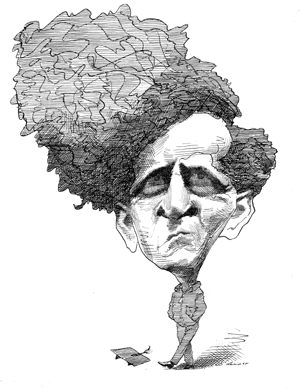
When people described Ramsey's concrete appearance, they tended to use the word "bulky." He was over six feet tall and heavily built. The philosopher Arthur McIver, who knew Ramsey at Winchester, described him as "an enormous human being similar a cross between a lighthouse and a balloon—like a Zeppelin fix on end." In one of his most frequently quoted remarks, Ramsey used his large frame to illustrate his Weltanschauung:
Where I seem to differ from some of my friends is in attaching petty importance to physical size. I don't feel the to the lowest degree humble before the vastness of the heavens. The stars may be big, but they cannot call up or honey; and these are qualities which impress me far more than than size does. I take no credit for weighing nearly seventeen stone [238 pounds].
You lot might think, when dealing with the life of a man who died at the age of twenty-six, particularly one who wrote so much in that curt time, that there would not exist much to say about his love life. In fact, notwithstanding, a surprising corporeality of this book is taken upwards with only that. Paul describes in detail Ramsey's unhappy and unreciprocated honey, at the age of 19, for a adult female called Margaret Pyke, who was married and had a child, and as well his relationship with his wife, Lettice, whom he met in 1924 and married the post-obit twelvemonth. Drawing extensively on correspondence between the two, Paul charts the ups and downs of this marriage, which produced ii daughters merely was not entirely happy considering of infidelities on both sides.
Ramsey was an extraordinarily intelligent homo whose every discussion on logic, mathematics, economics, and philosophy is worth contemplating. He was not, however, a great imaginative writer or a man blest, or cursed, with a particularly intense, unusual, or noteworthy emotional life. Thus, when talking about his romantic feelings, he appears as what in other matters he most assuredly was non: an ordinary man. While his wife was away in Ireland he told her, in the spirit of an open marriage, about a very satisfactory thing he was having with some other woman; when she wrote that she, besides, was having an affair, he erupted in anger.
So if we want to understand the admiration in which he is widely held, it does not help much to read his messages to Lettice. His sister would have done a much greater service to his memory if, also as writing at such length nigh his beloved life, she had described the context, content, and impact of the work on which his reputation as a philosopher rests. For during his v last years, the years of his union to Lettice, he published three seminal papers on philosophy—"Universals" (1925), "The Foundations of Mathematics" (1925), and "Facts and Propositions" (1927)—and wrote several more that remained unpublished until after his death.
Paul provides extremely cursory accounts of each of the published papers, but does lilliputian or nothing to provide a general label of the philosophical position that inspired them. She gives no articulate idea, for example, of how his philosophical thinking developed from his consideration of the age-old question "What is truth?," a question to which Ramsey responded with what is ofttimes called the "deflationary theory": to say that a proposition p is true is simply to assert p. "It is evident," he writes in "Facts and Propositions," "that 'Information technology is true that Caesar was murdered' means no more than that Caesar was murdered." From there, Ramsey went on to tackle what he regarded as the more difficult question, "What is belief?" Or rather, this is what he intended to do. His early death prevented him from completing this job.
The papers he left unpublished, still (most which Paul says almost cipher), provide prove that during the terminal year of his life Ramsey was moving away from the broadly Russellian views that he espouses in his published papers and toward a view more akin to the intuitionism associated with the Dutch mathematician 50. E. J. Brouwer—the belief that mathematical concepts are solely creations of the mind, with no external being. The story of this shift, and the function (if any) played in it past Ramsey's conversations in 1929 with Wittgenstein, would be of enormous interest to anyone concerned with the development of philosophy in the twentieth century. Without going into detail, we can at least say that he helped convince Wittgenstein to move past his work in the Tractatus; Wittgenstein himself said that his talks with Ramsey "educate[d] me into a degree of courage in thinking."
Whatever Ramsey was working on in 1929 was cutting short past his very untimely death in early 1930, which is described with great tenderness and sensitivity in Paul's final chapter. In Nov he was confined to bed with jaundice. Nobody thought much of it, only when, in January, he was still ill, he was moved to Guy's Hospital where an exploratory operation was carried out. Three days later he died, the crusade of death being given as hepatitis. Using contemporary accounts in the letters and diaries of Ramsey's friends and relatives, the last chapter of this memoir conveys vividly the shocked disbelief with which his decease was greeted.
With Ramsey's young death, the world of learning was robbed of one of its most glittering stars. Information technology is now time that he receive his due. What is needed is a thorough biography that would describe and place in intellectual history his important contributions to economics, mathematics, and philosophy, while keeping an eye out for what Virginia Woolf called the "fertile facts" that would reveal to us not only the impressive listen, but too the somewhat elusive personality of this extraordinary homo.
Source: https://www.nybooks.com/articles/2016/12/22/frank-ramsey-great-intellects/
0 Response to "â€ëœone of the Great Intellects ofã‚â Hisã‚â Timeã¢â‚¬â„¢ by Ray Monk the New York Review of Books"
Post a Comment