The Princeton Review Ap Physics C Practice Exam 2 Answers
The all-encompassing popularity of AP Physics courses is largely rooted in the introductory AP Physics 1 exam, with less than half equally many students taking the other three tests combined. AP Physics C: Mechanics is one of the highest levels of AP Physics, with only AP Physics C: Electricity and Magnetism post-obit it in the form sequence.
AP Physics C: Mechanics is the equivalent of a calculus-based, first-semester college physics course. Information technology is about ofttimes taken over the course of an unabridged school year but, in high schools that offer cake scheduling, can sometimes be taken during a single semester. For many students, it is the culmination of their loftier schoolhouse work in the physical sciences. In 2019, more than 57,000 students took the AP Physics C: Mechanics course, though less than half went on to accept AP Physics C: Electricity and Magnetism.
At that place's no doubt that if you lot can advance then far every bit to tackle this subject, you take already set your sights high, which is often the first step in setting yourself apart on college applications. If you lot're planning to take the examination, whether you lot're taking the form or self-studying, read on for a breakdown of the examination and CollegeVine's advice for how you can best prepare for information technology.
When is the AP Physics C: Mechanics Exam?
The AP Physics C: Mechanics is one of the kickoff AP exams administered. The exam occurs on Mon, May 11, at 12 pm. For the consummate AP exam schedule (including the revised Coronavirus dates), forth with study tips and more, check out our blog post 2020 AP Test Schedule: Everything You Need to Know .
About the AP Physics C: Mechanics Course
The AP Physics C curriculum is divided into two separate courses and exams. AP Physics C: Mechanics is nearly oft taken first, while AP Physics C: Electricity and Magnetism is usually taken later on, since a significant corporeality of its content builds on the textile from the Mechanics course.
When because which AP Physics track yous should pursue, exist certain to consider your classes in the context of your intended college path. Physics 1 and 2 are suited for students intending to pursue life sciences, pre-medicine, and some applied sciences, as well as other fields not straight related to science. Physics C, yet, is specially appropriate for students planning to specialize or major in the physical sciences or pursue a career in engineering. The AP Physics C: Mechanics class is equivalent to one semester of an introductory, calculus-based college physics course and will put aspiring engineers or physicists on track toward their goals.
AP Physics C: Mechanics Form Content
The AP Physics C: Mechanics course framework is divided into two essential components: science practices and big ideas. Through exploration of these 2 components, students gain a deeper agreement of the physical world.
Big Ideas: Big ideas are the core principles, theories, and processes of a discipline and provide a foundation understanding of a topic. The 4 big ideas of AP Physics C: Mechanics are:
| Big Idea | Description |
| Change | Interactions produce changes in move |
| Force Interactions | Forces characterize interactions between objects or systems |
| Fields | Fields predict and depict interactions |
| Conservation | Conservation laws constrain interactions |
Scientific Practices: Science practices are the skills needed to call back and act like a physicist. Because the course focuses heavily on science practices, students taking the AP Physics C: Mechanics class will spend a minimum of xx% of instructional time engaged in hands-on laboratory work. The 7 scientific practices, along with the weight they're given on the multiple-pick and complimentary-response sections of the AP Physics C: Mechanics exam are:
| Scientific Practice | Clarification | Weight on Multiple-Choice Section of Test | Weight on Free-Response Section of Exam |
| Visual Representations | Analyze and/or use representations of concrete situations, excluding graphs | 14%-17% | four%-7% |
| Question and Method | Determine scientific questions and methods | 3%-6% | half-dozen%-xi% |
| Representing Data and Phenomena | Create visual representations or models of physical situations | Not assessed | thirteen%-20% |
| Information Analysis | Analyze quantitative data represented in graphs | 14%-17% | 8%-13% |
| Theoretical Relationships | Determine the furnishings on a quantity when some other quantity or the physical situation changes | 25%-34% | 20%-24% |
| Mathematical Routines | Solve problems of physical situations using mathematical relationships | xiv%-xx% | 20%-24% |
| Argumentation | Develop an explanation or scientific argument | fourteen%-20% | eleven%-eighteen% |
AP Physics C teachers are free to organize the class content however they wish; still, the grade is commonly cleaved into vii units. Below is a wait at the seven units structured in a sequence recommended by the College Board, forth with the weight each unit is given on the AP Physics C: Mechanics exam:
| Unit | Weight on Multiple-Choice Department of Exam |
| Kinematics | 14%-xx% |
| Newton'southward Laws of Motion | 17%-23% |
| Work, Free energy, and Ability | fourteen%-17% |
| Systems of Particles and Linear Momentum | 14%-17% |
| Rotation | 14%-20% |
| Oscillations | 6%-14% |
| Gravitation | 6%-xiv% |
AP Physics C: Mechanics Prerequisites and Credit
Though there are no prerequisites in terms of prior physics classes for this course, students should exist prepared for college-level, calculus-based work and must, at minimum, have taken or be meantime taking calculus. Considering a previous or concurrent grade in calculus is often required of students taking Physics C, students who expect advanced placement or credit in college for a Physics C exam should endeavour an AP course in calculus as well; otherwise, placement in the next-in-sequence physics course may exist delayed or even denied.
Keep in mind that credit and avant-garde standing based on AP scores vary widely from school to school. Though a score of 3 is typically considered passing, it is not always enough to receive credit. Regulations regarding which APs qualify for course credits or advanced levels at specific colleges are bachelor on the College Board website.
AP Physics C: Mechanics Exam
The AP Physics C: Mechanics examination is one of the shortest AP exams, clocking in at just ane hour and xxx minutes. It comprises two sections: one department of multiple-choice questions and one section of free-response questions.
Section one: Multiple Choice
45 minutes | 35 questions | 50% of score
The start department of the AP Physics C: Mechanics examination contains 35 multiple-choice questions, spans 45 minutes, and accounts for 50% of your total score. The questions are both stand up lonely and grouped into sets using the same stimulus or information set.
Below is an instance of a standalone multiple-choice question:
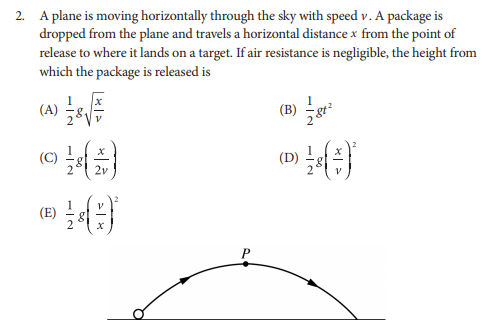
Reply: D. Source: College Board.
Below is an example of a set up of questions based on a single stimulus:
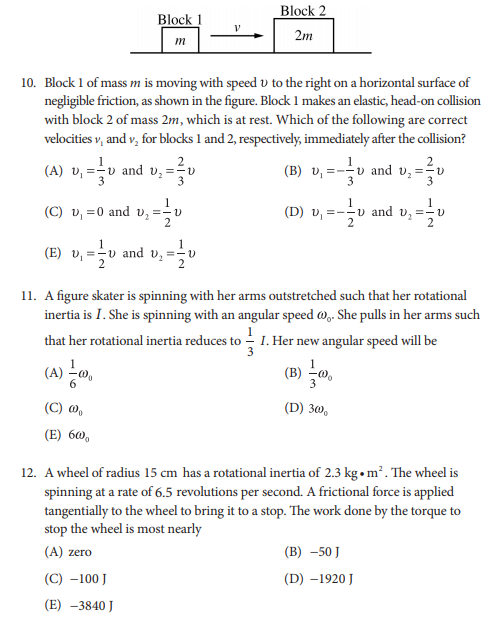
Answer: x: B, 11: D, 12: D. Source: College Board.
Section two: Gratis Response
45 minutes | 3 questions | 50% of score
The second part of the examination is the free-response section, which also lasts 45 minutes and accounts for the remaining 50% of your score. There are three free-response questions roofing all 7 of the scientific practices and you're given 15 minutes to answer each.
Beneath is an example of a free-response question:
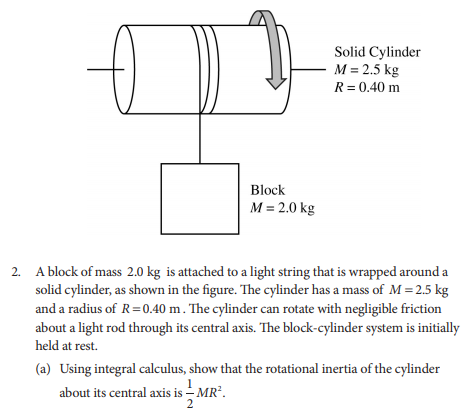
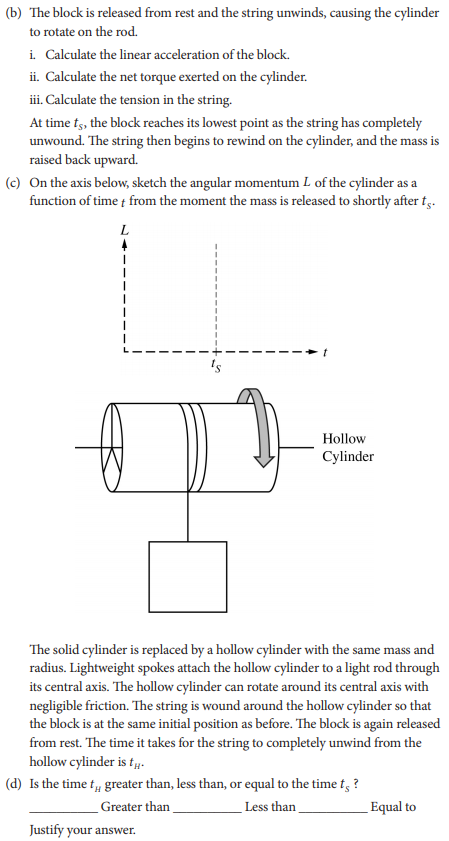
Source: College Board.
You are expected to bring and utilise a iv-function graphing or scientific calculator on the exam. You should be familiar with your computer and it is a good idea to bring extra batteries for it. Yous may not share calculators during the exam, but you may bring up to two calculators. The complete calculator policy and a list of acceptable models is available on the College Board website.
AP Physics C: Mechanics Score Distribution, Average Score, and Passing Rate
| Exam | 5 | iv | 3 | 2 | 1 |
| AP Physics C: Mechanics | 37.7% | 26.7% | 17.4% | 10% | 8.2% |
In 2019, the exam had the highest pass rate of whatever of the AP Physics exams. Over 80% of all students taking the test in 2019 received a score of 3 or higher (typically considered passing). Of these, more than a third of students who took the exam received the top score of five while just viii.two% received the lowest score of 1.
A total course description that can help to guide your studying and understanding of the knowledge required for the test can be found on the College Board grade website .
Tips to Prepare for the AP Physics C: Mechanics Examination
Footstep ane: Assess Your Skills
You'll need to beginning your prep piece of work past taking a exercise exam to assess your initial cognition of the textile.
You tin find many sample questions with scoring explanations included in the course description , and more are bachelor in the consummate released 2012 exam . Commercial study guides may also comprise a number of practice or diagnostic tests to utilize as a formative assessment.
Step 2: Written report the Textile
The theory that you will need to know for AP Physics C: Mechanics ranges greatly in depth. You volition need to grasp large theoretical concepts, highly specific applications of principles and equations, and everything in betwixt. You should be comfortable using integral and differential equations to make quantitative calculations related to the fabric.
As in earlier physics classes, you will apply your cognition of the core content to hands-on laboratory investigations. These investigations allow teachers to provide a more engaging and rigorous feel for AP Physics students. In laboratory investigations, which should account for 20% of your grade time, y'all will found lines of prove and use them to develop and refine testable explanations and predictions of natural phenomena. You should be able to:
- design experiments
- detect and measure real phenomena
- organize, display, and critically analyze data
- analyze sources of error and determine uncertainties in measurement
- draw inferences from observations and data
- communicate results, including suggested ways to ameliorate experiments and proposed questions for further study
For a more specific idea of where to focus your studying, y'all may consider using a commercial report guide. The Princeton Review's Peachy the AP Physics C Examination, 2020 Edition: Practice Tests & Proven Techniques to Help You Score a v provides a fairly comprehensive guide to the exam content, though at virtually 700 pages, it is sometimes criticized for its length. Another solid option is Barron'south AP Physics C, 4th Edition , which is almost equally long but likewise contains a diagnostic test and two complete practice tests with scoring explanations.
Additionally, there are a number of costless study resources available online. Many AP teachers have posted complete study guides, review sheets, and test questions. One complete study guide and a comprehensive database of written report guides by subtopic are available besides. There are besides several free video tutorials .
Finally, familiarize yourself with the tools that volition be available to you during the exam. Make sure that you lot know how to use your calculator finer. Also review the table of equations that volition be furnished to you during the exam.
Step 3: Do Multiple-Selection Questions
When you feel confident that you've thoroughly studied the required material, test your knowledge past practicing multiple-choice questions. You tin find these in almost study guides or through online searches— Varsity Tutors and Study.com are great places to start. You could likewise attempt taking the multiple-selection section of another practice exam. There are gratuitous online multiple-selection questions bachelor and other written report resources .
The College Lath Form Description includes many practice multiple-pick questions along with explanations of their answers. Equally you go through these, try to keep track of which areas are still tripping you up and go back over this theory once more. Focus on understanding what each question is asking, and keep a running list of whatever concepts that are even so unfamiliar.
Step iv: Practise Complimentary-Response Questions
The AP Physics C: Mechanics examination contains very specific central words in the free-response prompts. These words give yous clues as to what the exam readers are looking for in your response, and then you should study them closely. Exam readers will expect that y'all pay close attention to the task verbs used. On the examination, these most commonly include: justify , explicate , calculate , compare , determine , derive , sketch , and plot . Know precisely what each ane of these words is request you to practise. The definitions of these words tin can be found kickoff on folio 147 of the AP Physics C course clarification .
As you tackle the free-response section, underline each section of the prompt, circle the job verb, and bank check them off as you write. If yous are asked to justify a numeric respond, brand sure to include a verbal explanation of how you reached your solution. Many students lose points by just forgetting to include 1 part of a multi-role question.
When working on the free-response section, you lot should remember that credit for the answers depends on the quality of the solutions and the explanations given. Partial solutions may receive fractional credit, so yous should show all your work. Too, correct answers without supporting work may not earn full credit. Be sure to show all your work in the infinite provided. If yous need boosted space, clearly indicate where the work is continued. Exam readers will not guess your intentions, so if they are not articulate, you will not receive credit. Similarly, if you make a mistake, erase information technology or cross information technology out. You volition lose credit for incorrect work, whether information technology is used toward your final solution or non.
Exist sure to also review the examples of scored free-responses then that you can understand exactly what to expect in this section and how you will be evaluated. The College Board provides many examples of bodily prompts from past years and includes authentic student responses with scores and an explanation on why they were scored that way.
For even more than tips, read the Higher Board's list of strategies on the Test Practice folio.
Pace 5: Take Some other Practice Examination
Equally you did at the very beginning of your studying, take a practice examination to evaluate your progress. You lot should see a steady progression of knowledge, and information technology's likely that yous will see patterns identifying which areas have improved the nearly and which areas notwithstanding need improvement. If you accept time, repeat each of the steps in a higher place to incrementally increment your score.
Step 6: Exam Twenty-four hours Specifics
If you're taking the AP course associated with this exam, your teacher will walk you through how to register. If you're self-studying, cheque out our web log mail service How to Self-Register for AP Exams .
For data almost what to bring to the exam, meet our post What Should I Bring to My AP Exam (And What Should I Definitely Leave at Habitation)?
Desire access to expert higher guidance—for complimentary? When y'all create your CollegeVine account, y'all'll find out your real admissions chances, build a best-fit school listing, learn how to ameliorate your profile, and get your questions answered by experts and peers—all for free! Sign up for your CollegeVine account today to get a boost on your college journey.
Interest in learning more about the APs? If and then, cheque out these other CollegeVine posts:
2020 AP Exam Schedule
How Long is Each AP Examination?
Easiest and Hardest AP Exams
Source: https://blog.collegevine.com/ultimate-guide-to-the-ap-physics-c-mechanics-exam/
0 Response to "The Princeton Review Ap Physics C Practice Exam 2 Answers"
Post a Comment